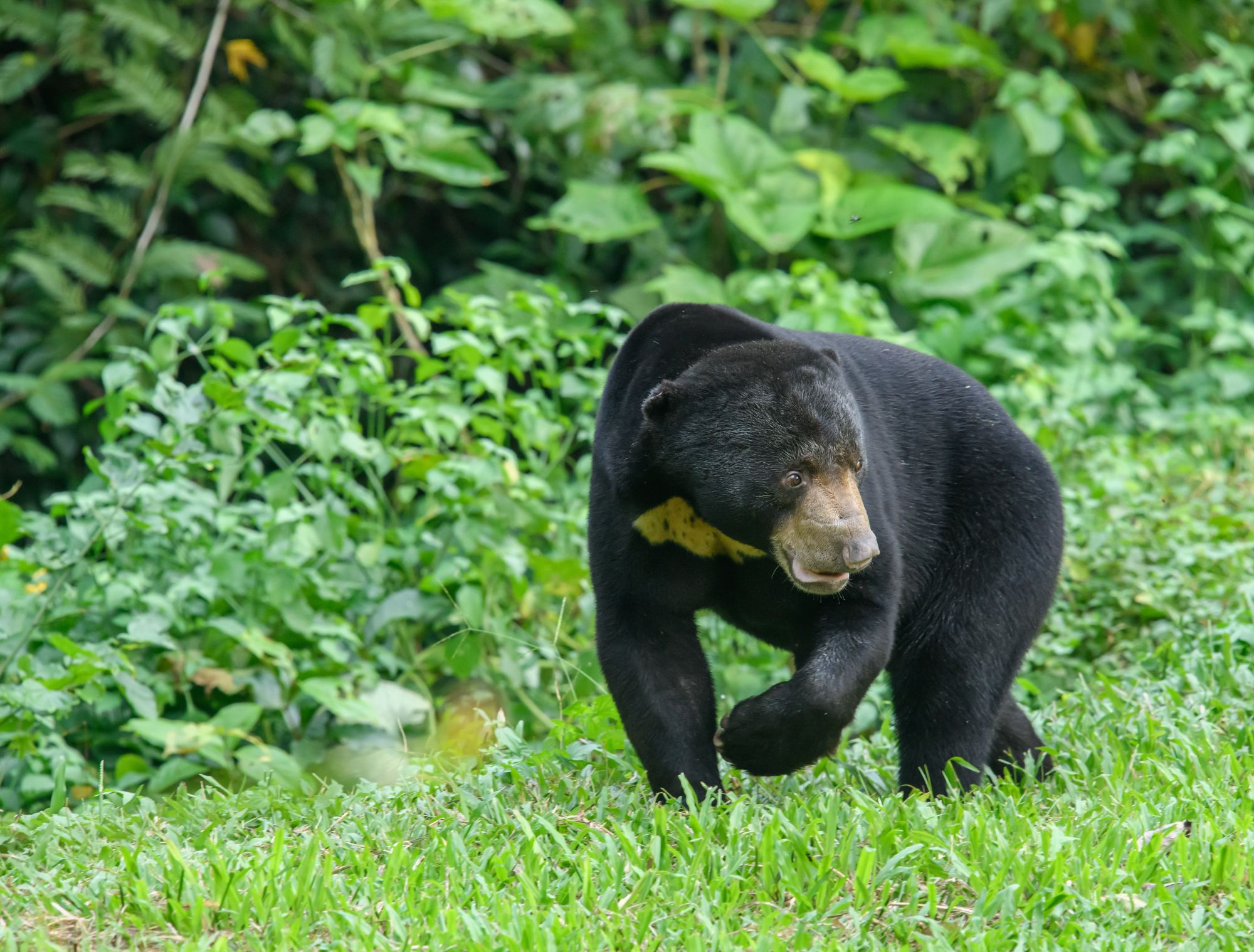
Story by Steve Frankham. All photos and videos by Steve Frankham except where credited. Sunbear image courtesy of Wiki Commons and Thai National Parks
The mighty jungle
A strange sound jerked me from my slumber. The half-light of pre-dawn was filtering in through the mosquito net of the tent, the trunks of the rainforest trees rising like giant sentinels a few meters away. I propped myself up on my elbows, stiff from a night of broken sleep on the hard ground. The torrential rain of the night before had ceased. All was quiet apart from the insistent hum of forest insects.
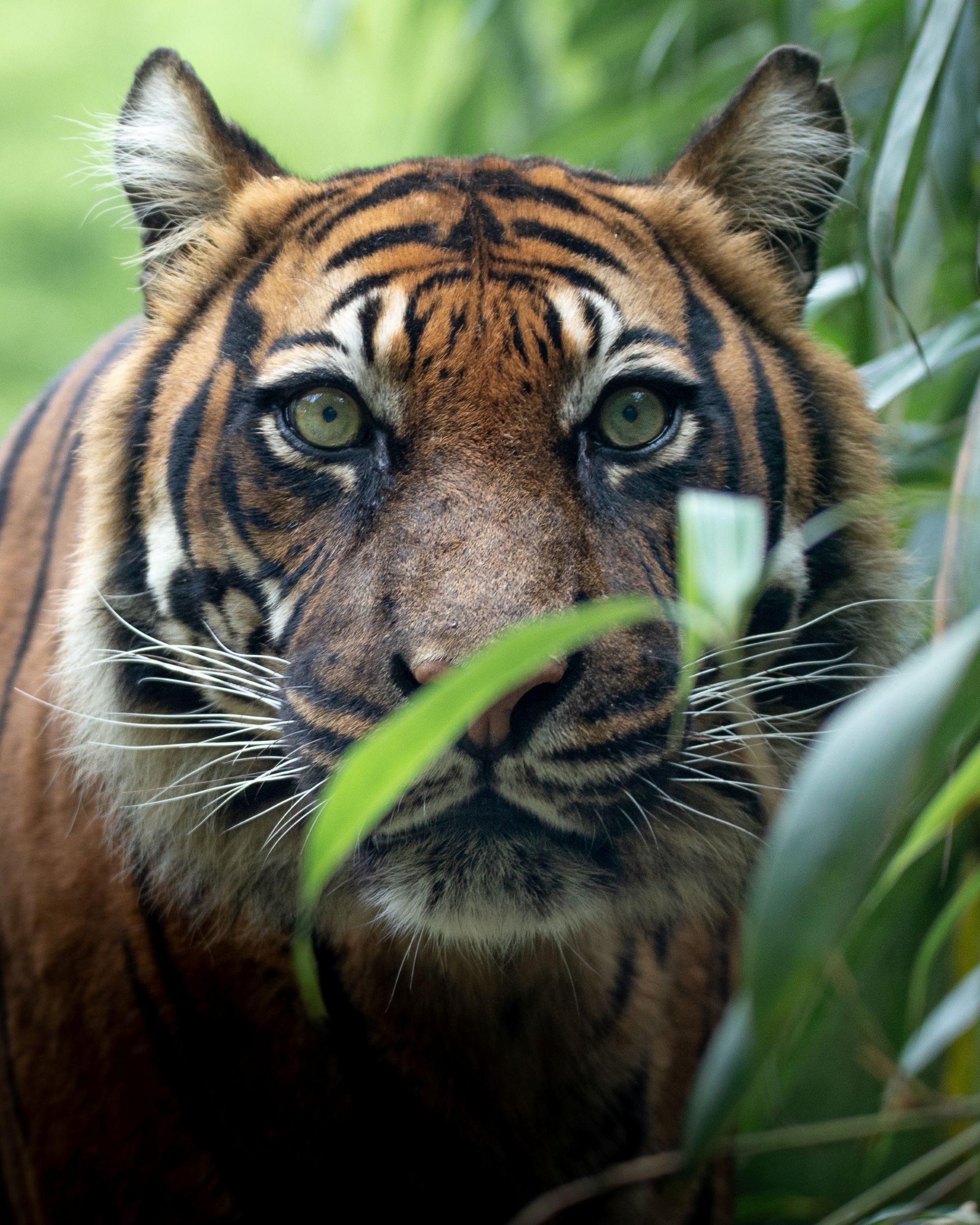
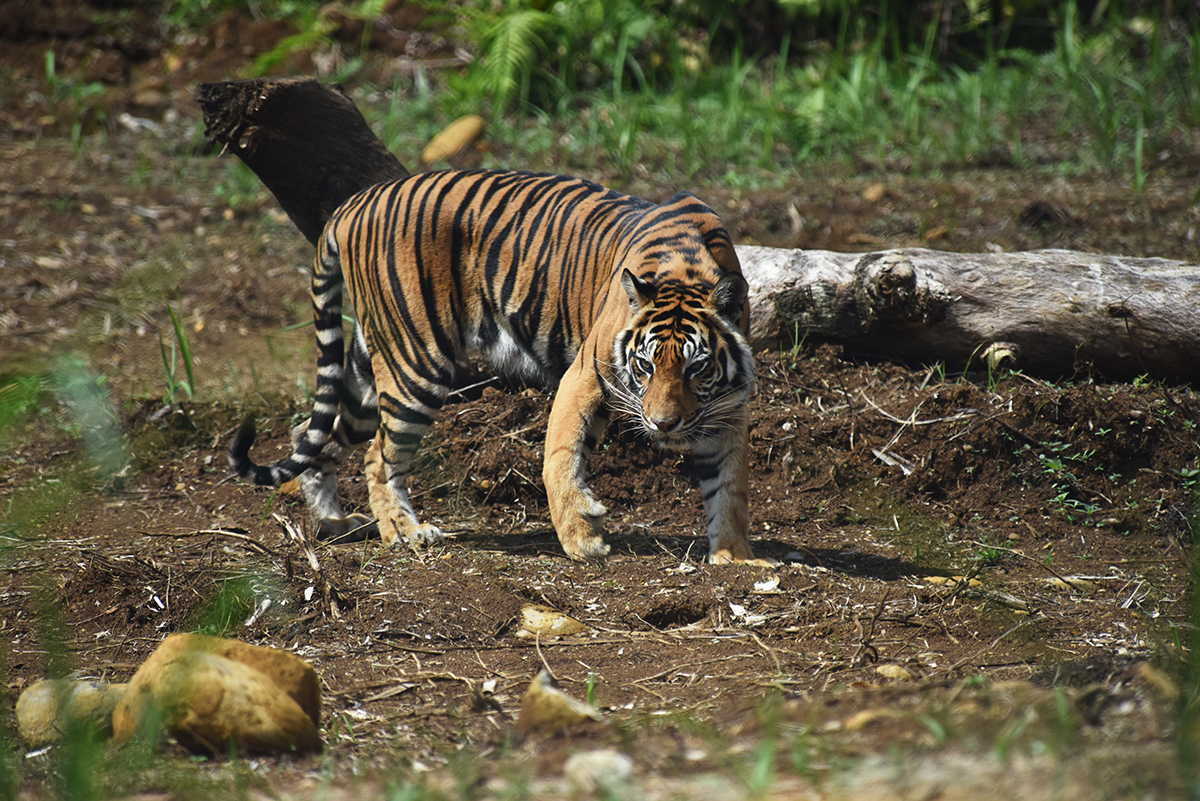
I was two days hike into the dense, primaeval rainforests of Kerinci Seblat National Park, Sumatra’s largest protected area. The park covers 13,791km² of steep, forest-cloaked mountains and valleys on the island’s western flank. Situated on ‘the ring of fire’, one of the world’s most tectonically active faults, the park is home to 5 volcanoes, including the highest in Indonesia, the 3805m Gunung Kerinci itself, which towers over the valley at the park’s heart. Kerinci is also home to the largest remaining population of Sumatran tigers, perhaps 190 animals, making the park critical for species survival on the island.
The call of the forest
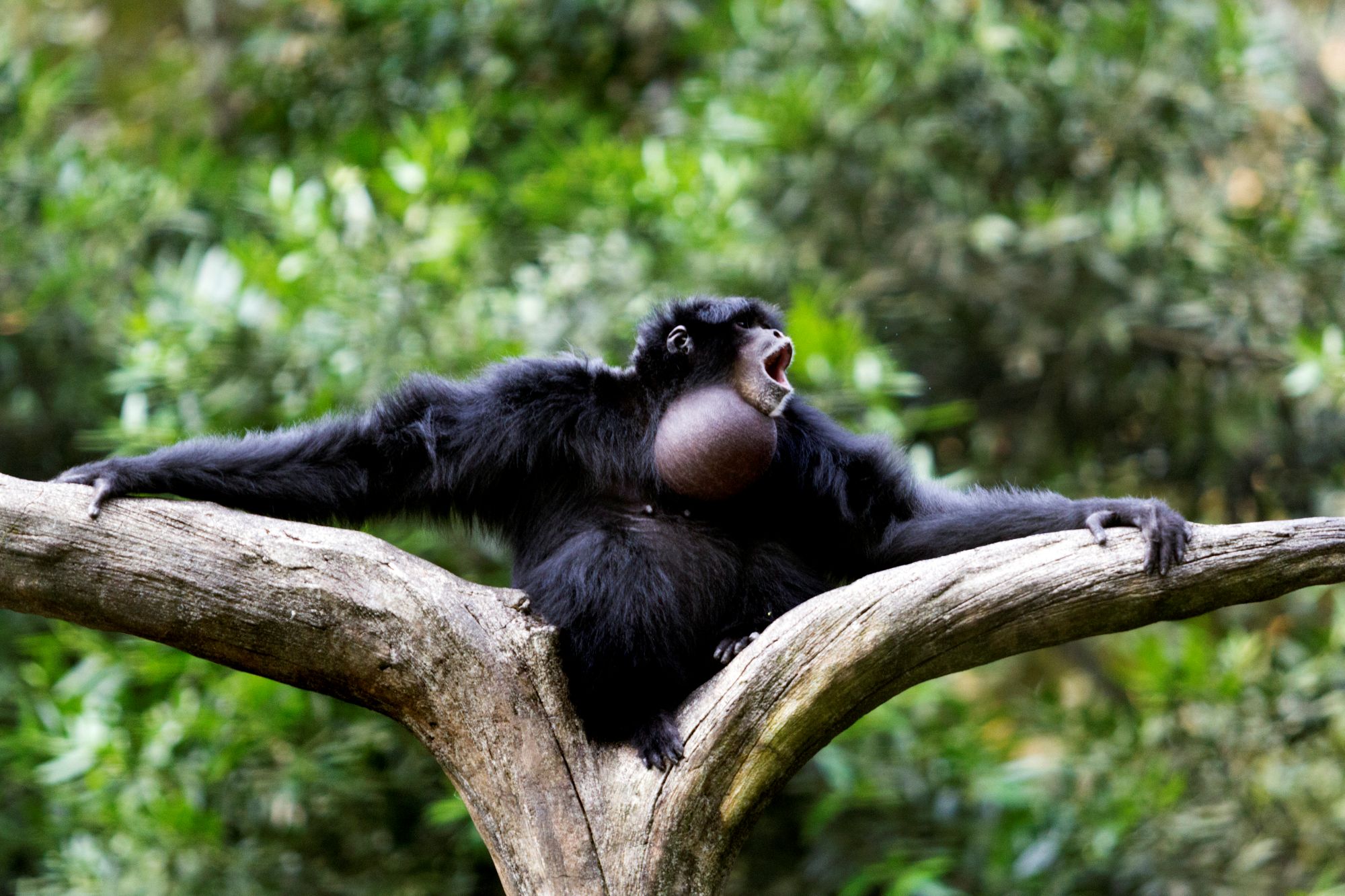
Waking up to the sound of gibbons
The sound I’d heard wasn’t a tiger, though. Could it be some kind of bird? I listened intently. The sound echoed through the forest once more.
“Ooohhh, hooh, hooh, hoooh…” then tailing off into a staccato, laugh-like sound, a “Haa ha ha ha ha…”.
It was the haunting call of one of our closest relatives, and the largest of the gibbon family, the Siamang Gibbon. I lay listening to the haunting sound for a few minutes before coaxing my aching muscles into action, pulling myself to a sitting position, and beginning to pack my bag. I yanked on a fresh T-shirt, in the certain knowledge that in a couple of hours it would be nothing but a sweat-soaked rag. My damp, mud-saturated T-shirt from the day before was chucked into the ‘dirty’ bag. To be fair, trying to keep anything half dry or clean in this untamed place was a fool’s game.
Into the light
Grabbing my toothbrush and a water bottle, I staggered out of my tent and sat myself down on a giant moss-encrusted log, listening to the gibbon’s call. The bright rays of sunlight, lancing down through the forest canopy, made the ferns and vegetation sparkle, giving the scene a mystical, elfin beauty. It was quite different from the afternoon before, when we scrambled for the shelter of our tents, under steel grey skies that sheeted water down upon us. The jungles of Kerinci are beautiful but also unforgiving for casual visitors. They are as wild as any jungle I have visited, and I have spent time in many.
An unforgiving land
The day before, we had hiked from the mesmerising, luminous blue Lake Kaco, a volcanic spring lake and relatively popular ‘tourist spot’ in the jungle, both for the few foreigners to make their way to Kerinci, and for locals. The way to Kaco is a muddy but fairly well-trodden route.
As soon as you pass the lake, any further progress was essentially bushwhacking, machetying through the undergrowth, pulling myself up the sides of steep gorges, grabbing roots, vines, or anything half-solid as the saturated earth collapsed and under me, and sliding on my ass down slopes, hoping not to impale myself on razor-sharp shards of bamboo. The terrain being so unforgiving, we’d repeat the process many times each day, for the next few days. The situation wasn’t helped by the fact that I’m waiting for a hip operation, and that lack of hip flexibility makes navigating this terrain doubly challenging.
Tarzan and the boys
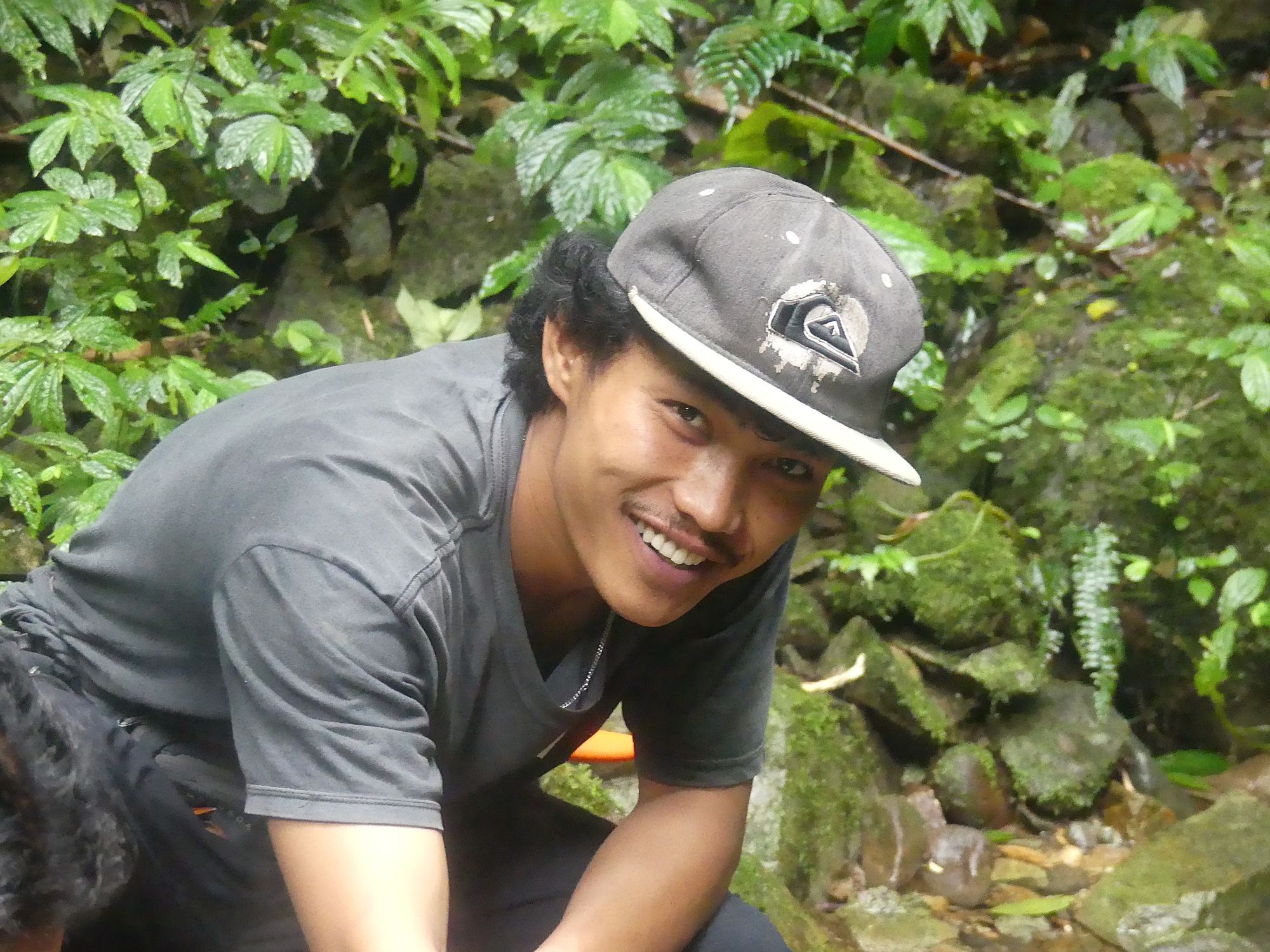
Many times, faced with a vertical climb and no roots to grab, my three guides and companions, Hutmi, Zalo (also known by the nickname ‘Tarzan’, due to his long, wild hair and rugged looks), and Heggel, would literally pull me up a section as the ground collapsed underneath me. Of course, my guides, all locals, traversed the terrain with the surefootedness of mountain goats – it was just another day in the office for them! For me, it was unnerving, to say the least. That’s what it takes to access this, the wild heart of Sumatra!
As I sat on the log, I heard my companions stirring in their tent. Soon the Hutmi’s perennially chirpy voice floated through the forest, asking if I would like coffee and breakfast…
“100%! Many thanks!” I would need every last bit of energy I could muster to make it down to the large river that would be our camp that evening, deep in the heart of the forest.
A future for the wild?
I had come to Kerinci to find out what remained of Sumatra’s wilderness and how wildlife on the island was coping under the immense pressure humanity was placing on the island’s forests. Sumatra is a vast island, the 6th largest on the planet, nearly 2000km in length, covering an area roughly the size of Spain.
During my childhood, it captured my imagination as an island where tigers, elephants, rhinos, and orangutans roamed together, and indeed this is still true (although all these species can only be found side by side a little further north, in Gunung Leuser National Park). Having said this, the island has endured some of the world’s worst rates of tropical deforestation over the last half-century. Currently, only 25% of Sumatra retains its original forest cover, down from 57% in 1985. It’s an ecological disaster by any metric. But can what’s left be saved? That’s what I had come to find out.
Padang
A few days earlier, I had flown into the relaxed medium-sized city of Padang on Sumatra’s West Coast. Having seen all sorts of environmental destruction over the years, I was prepared for the worst; however, as the plane banked and approached Padang, I let out a sigh of relief. The plane skimmed over the ocean dotted with forest-cloaked islands. In many places on the mainland, the rainforest reached all the way from the mountains down to the sea.
I was the only ‘westerner’ on the flight, a testament to the fact that this part of Sumatra is off the regular ‘tourist trail’. That’s not to say that Padang is completely untouristed, but its fame only stems from being the launch point for boats to the Mentawi Islands. The Mentawis are renowned for their world-class surf breaks.
A cultural mix
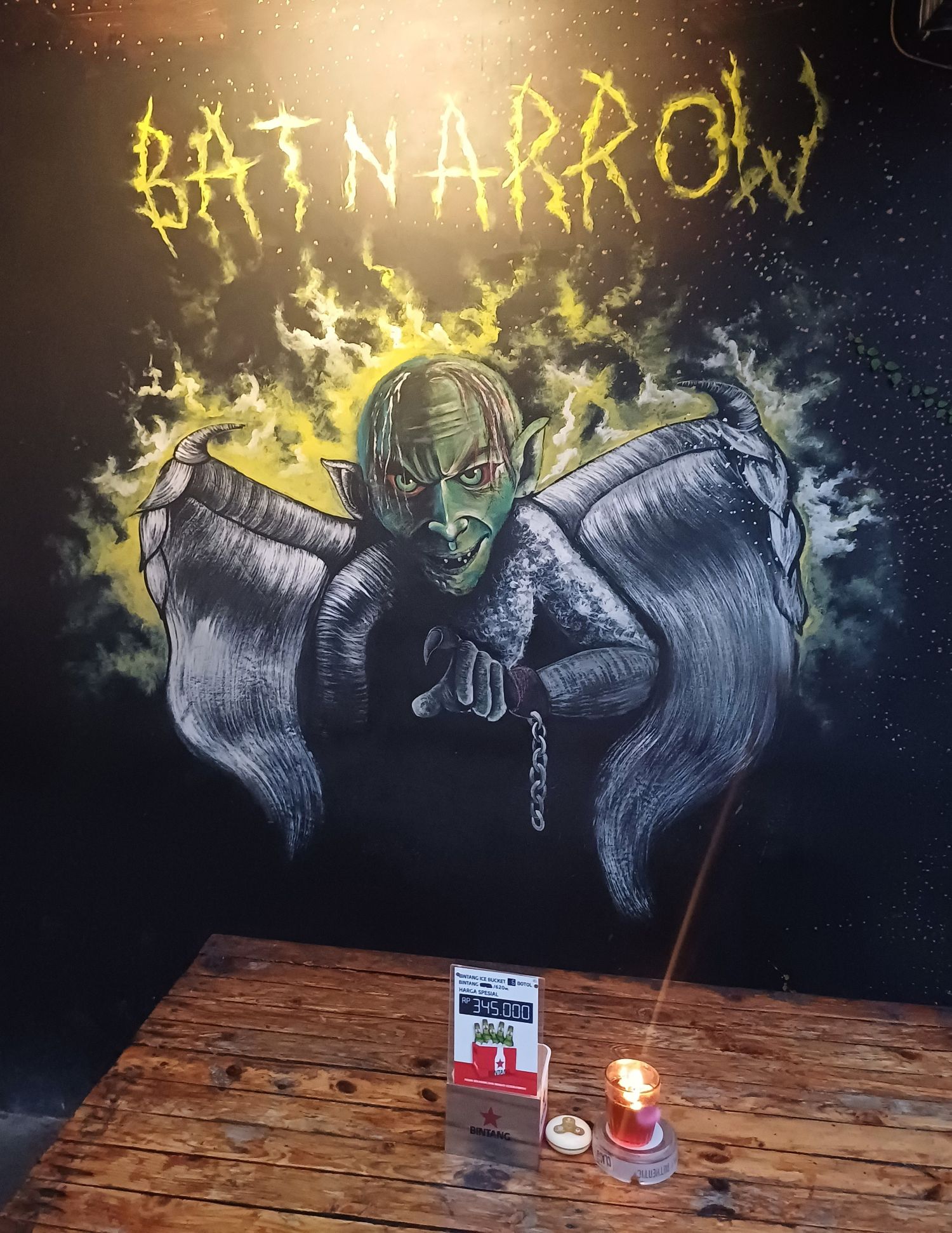
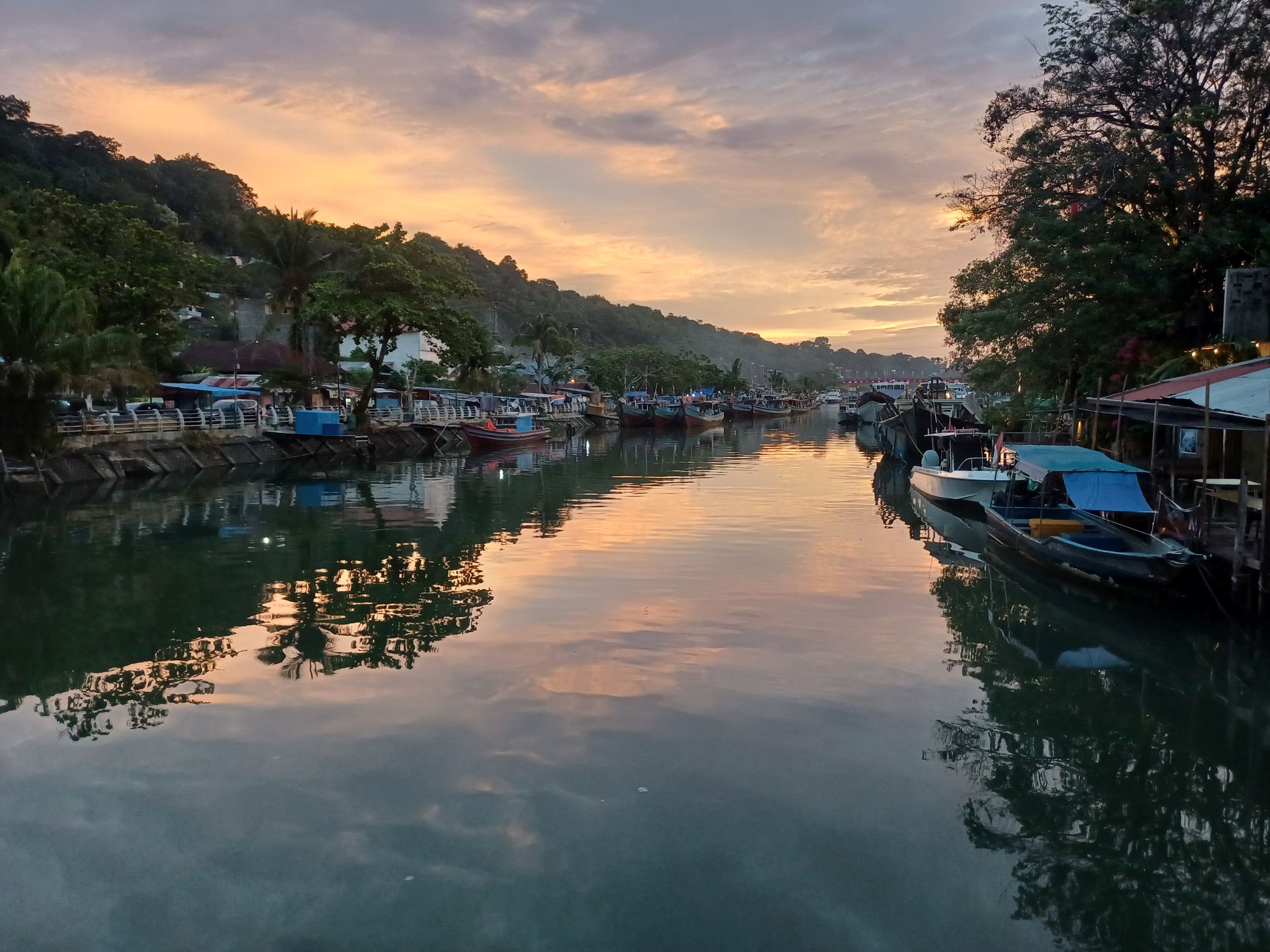
Touching down, I took the recently completed train from the airport into the centre of town, zipping past rice paddies, rivers and small hamlets. The city itself is a low-rise, relaxed sort of place. My kooky, economical accommodation, The Bat and Arrow, had its garden directly fronting onto the river where most of the Mentawi surf liveaboards docked. It also seemed to be the centre of Padang ‘Nightlife’. It was a place where a relatively conservative Muslim society rubbed somewhat uneasily up against the ‘hang ten’ surfy vibe. Its bar was popular with young local boys and girls, seeking something different and perhaps freer than local culture.
A problem of awareness
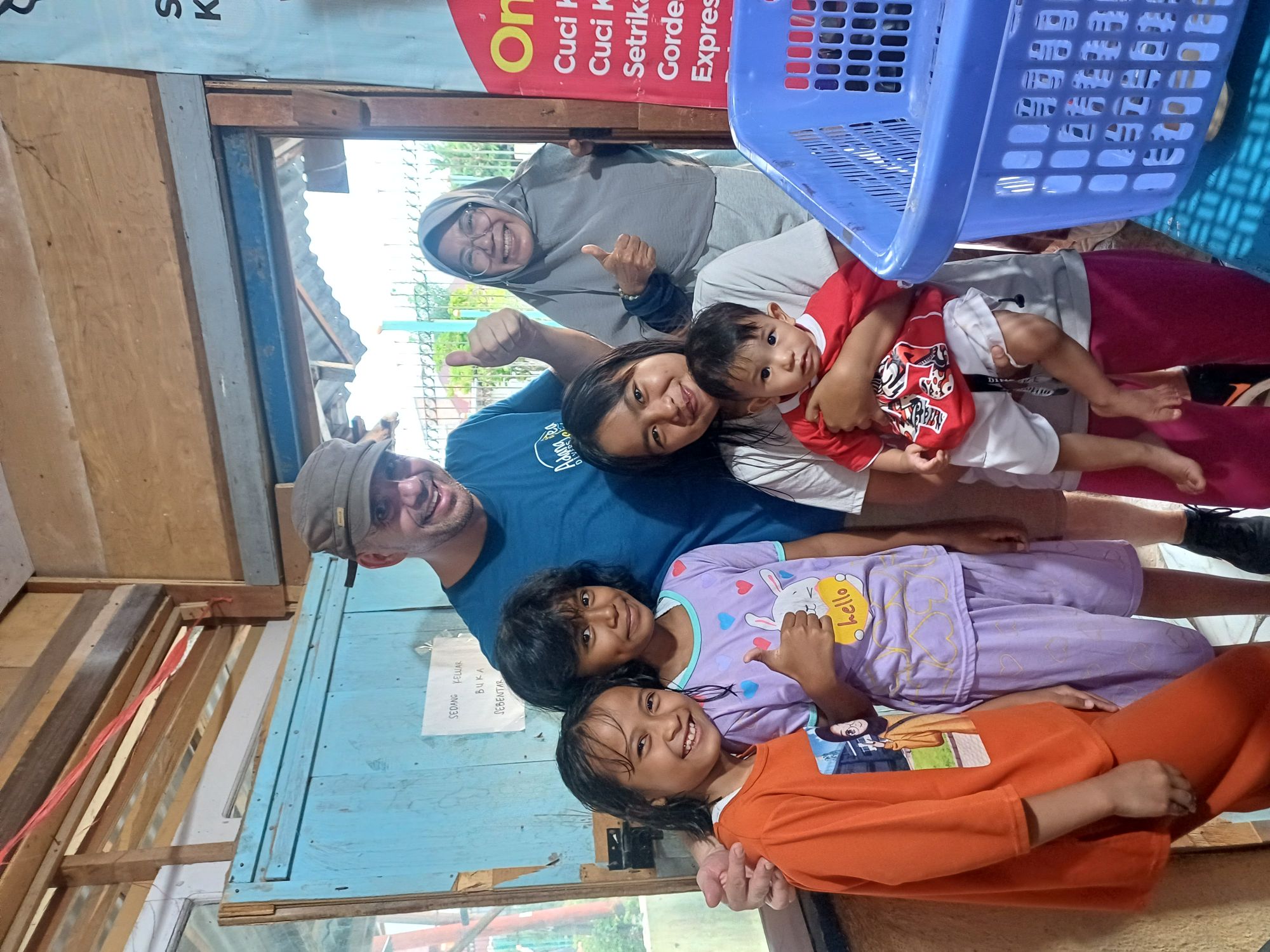
As usual, most locals were friendly, curious, and welcoming. Everyone, local or foreign, assumed I’d come to surf. When I informed them that I’d come to visit Kerinci Seblat National Park, to explore the jungle, I was met by quizzical looks that screamed ‘What the hell, why??’ Some didn’t even seem to know about the existence of the National Park, an ecological marvel on their doorstep. A section of the National Park literally fringes the town. This, in itself, is a problem that needs to be addressed. How can a park be protected if the local population don’t know about and value it?
Although Padang is a pleasant enough place, I would be lying if I said it had many attractions, beyond good food and watching untouristy local life unfold. I had a couple of days before my bus up into the Kerinci Valley, so I resolved to explore the coast south of Padang.
Pantai Carolina
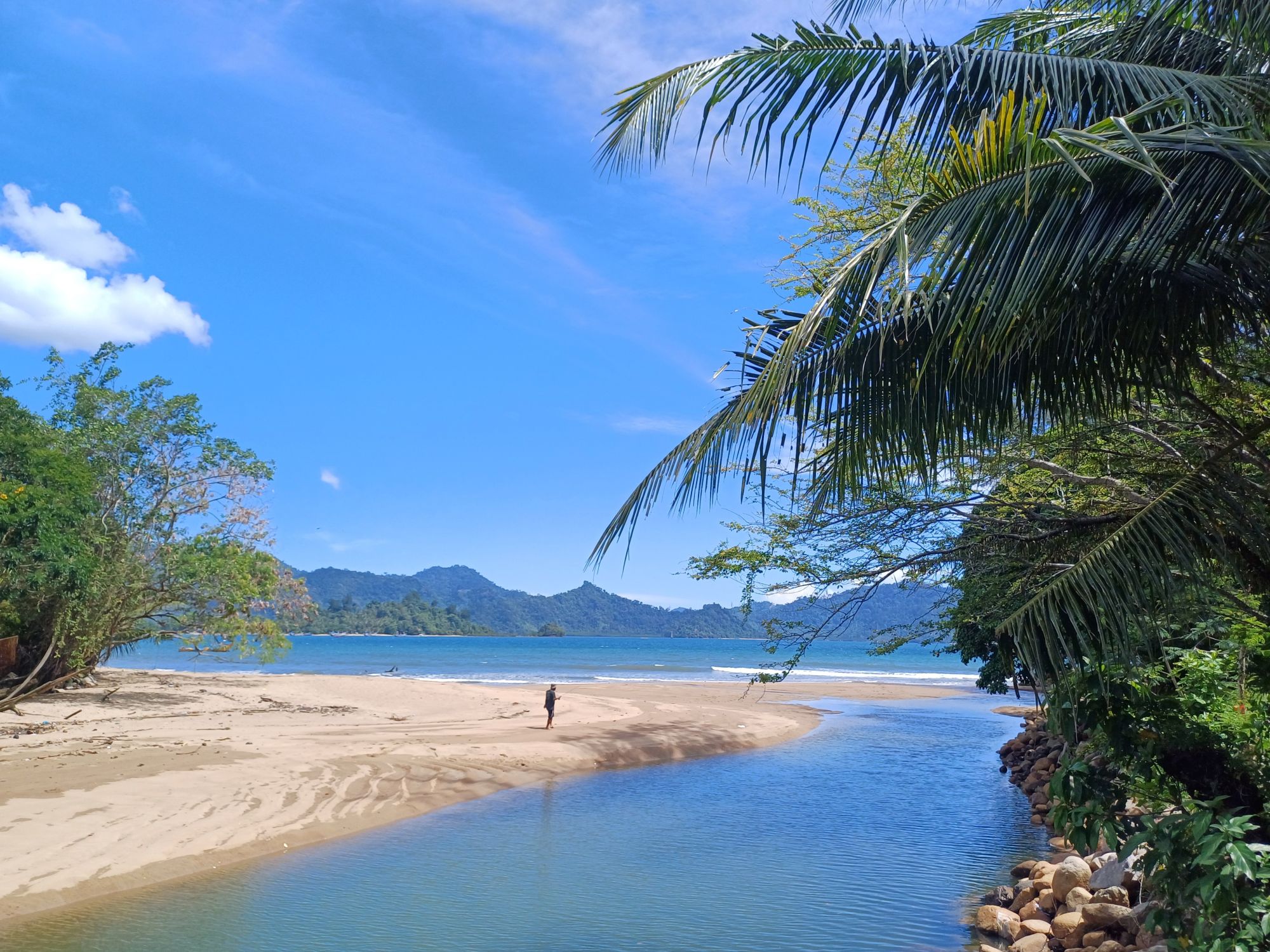
The next morning, I was heading across the bridge, out of Padang with Dudi, a friendly local driver. Within minutes, we were traversing the serpentine coastal road through thick rainforest. We wound up and down hills and crossed peninsulas, past isolated villages, and circumvented palm-fringed bays.
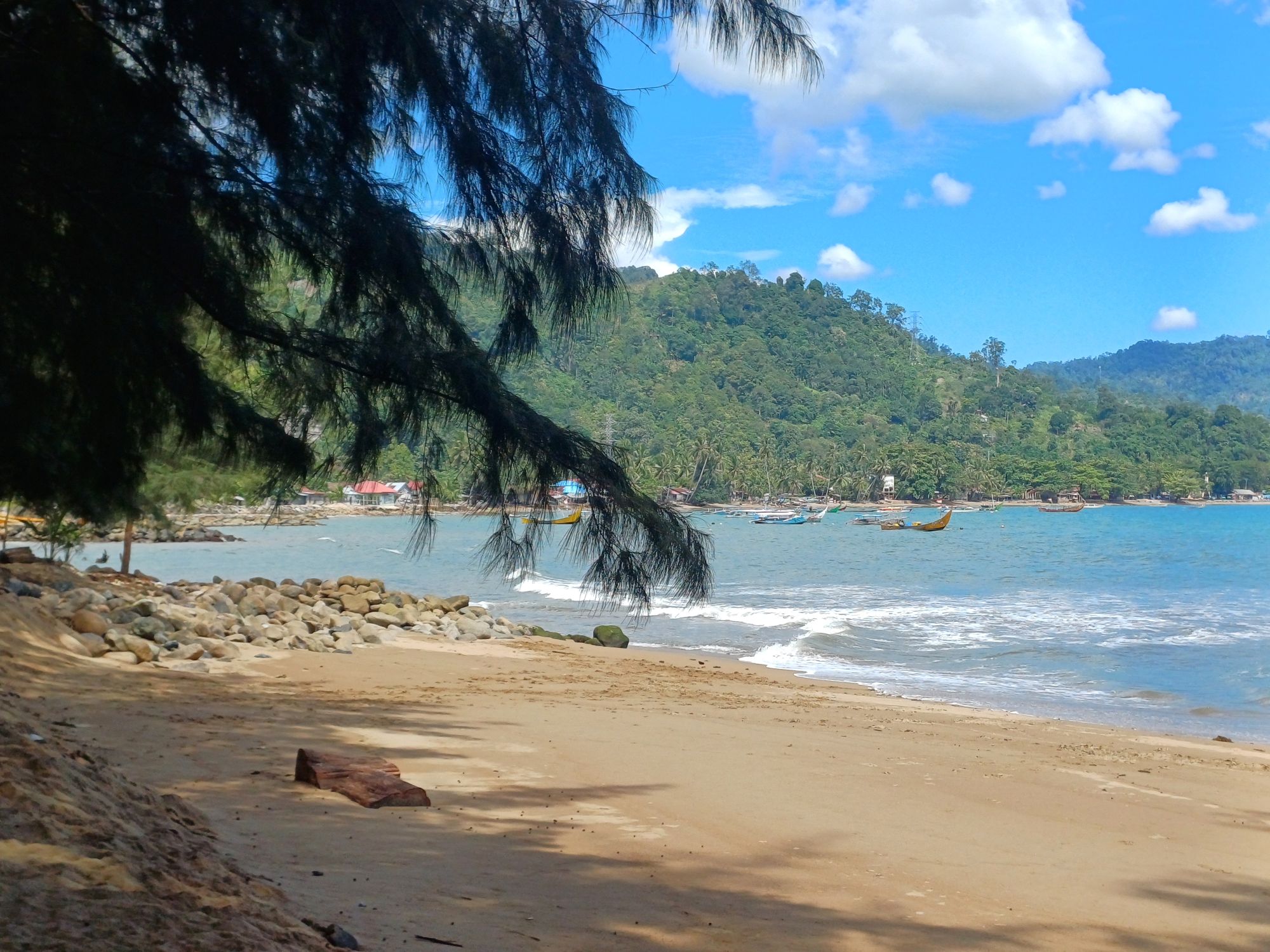
One of those bays was Pantai Carolina, our first stop, a beautiful beach, utterly devoid of tourists (although apparently popular with locals at the weekend). The only other people on the beach were a bunch of local kids messing around in the waves a hundred or so meters away. It was a lovely spot. I dived in and had my first Indonesian swim…the water was actually hot. Perhaps this was a disturbing sign of rising sea temperatures, but I had the whole bay to myself. In most parts of the world, a beach like this would be packed to the gills, but here, in isolated West Sumatra, it was empty.
To Ricky’s
Back on the road, we had time from one more stop, at a place that had a brief mention in the guidebook…Ricky’s Beach House. Dudi hadn’t heard about it, which again surprised me; it reinforced how many local attractions with potential were unknown to locals. It was a good distance further south, but the landscape as we cruised south only seemed to get wilder and more spectacular. The rainforest-cloaked islands I’d seen from the plane dominated the seascape. Eventually, we came to a rough dirt track that diverted from the road. We bumped down the road through the jungle to the beach.
The sweet spot
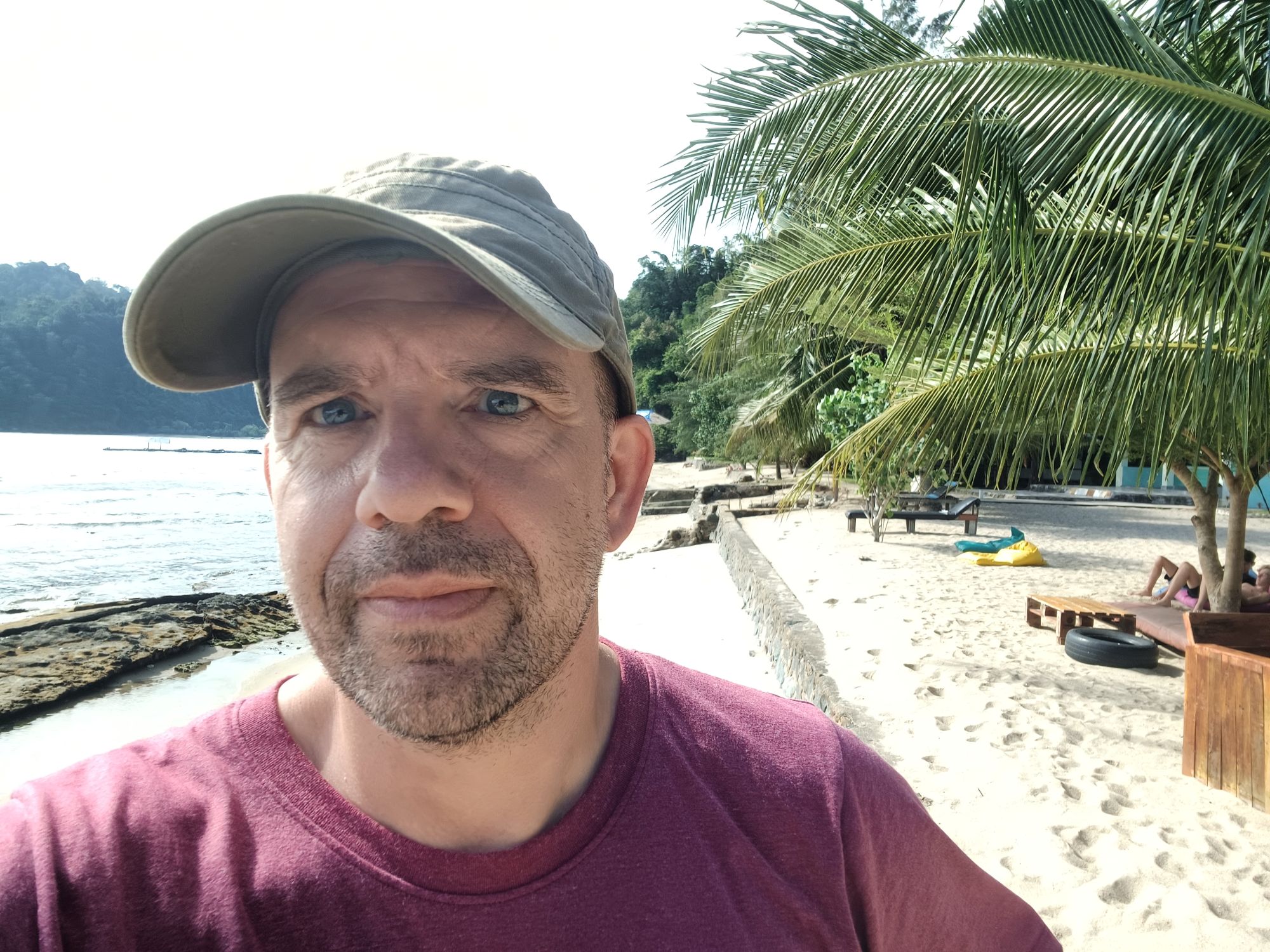
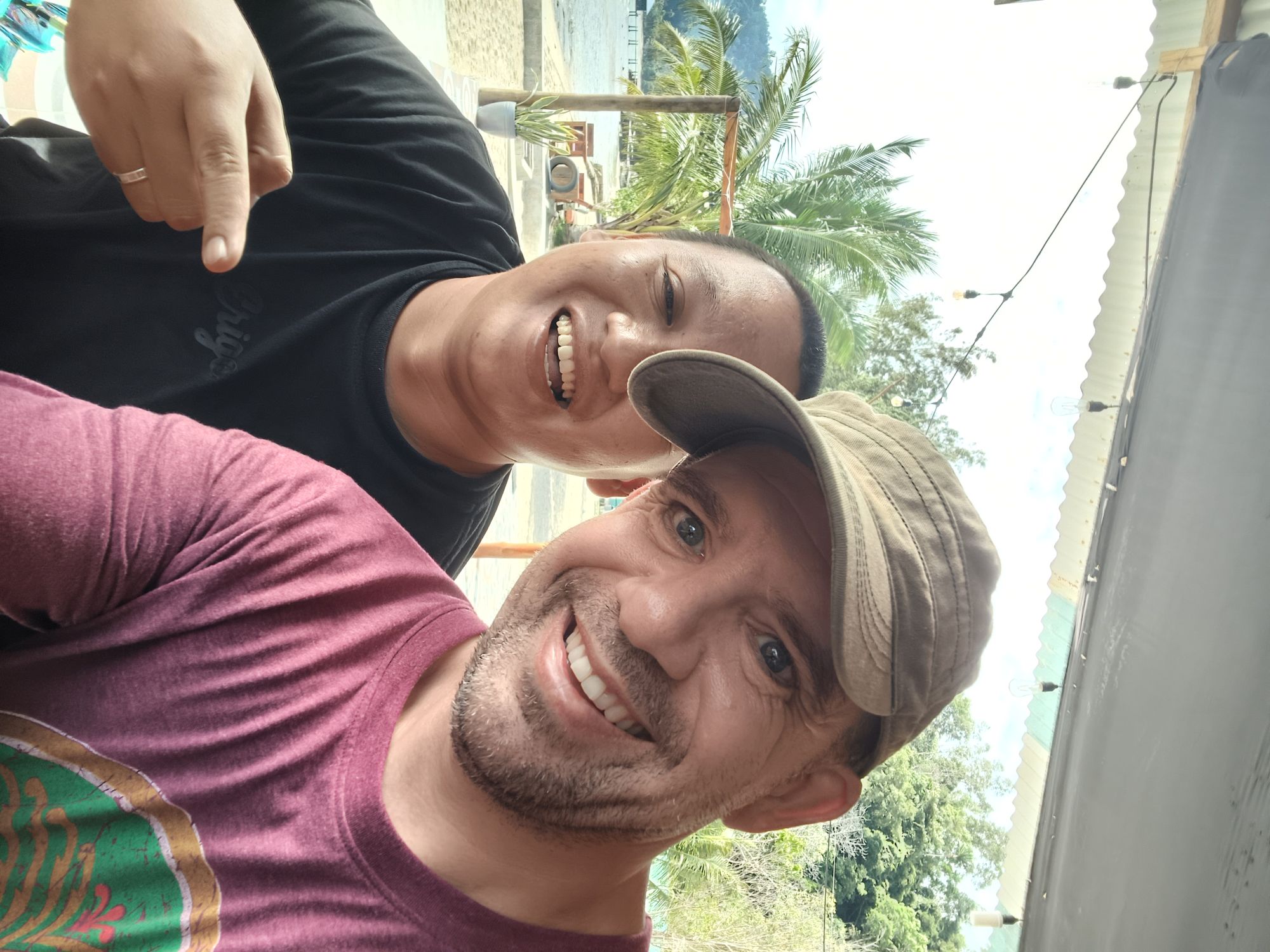
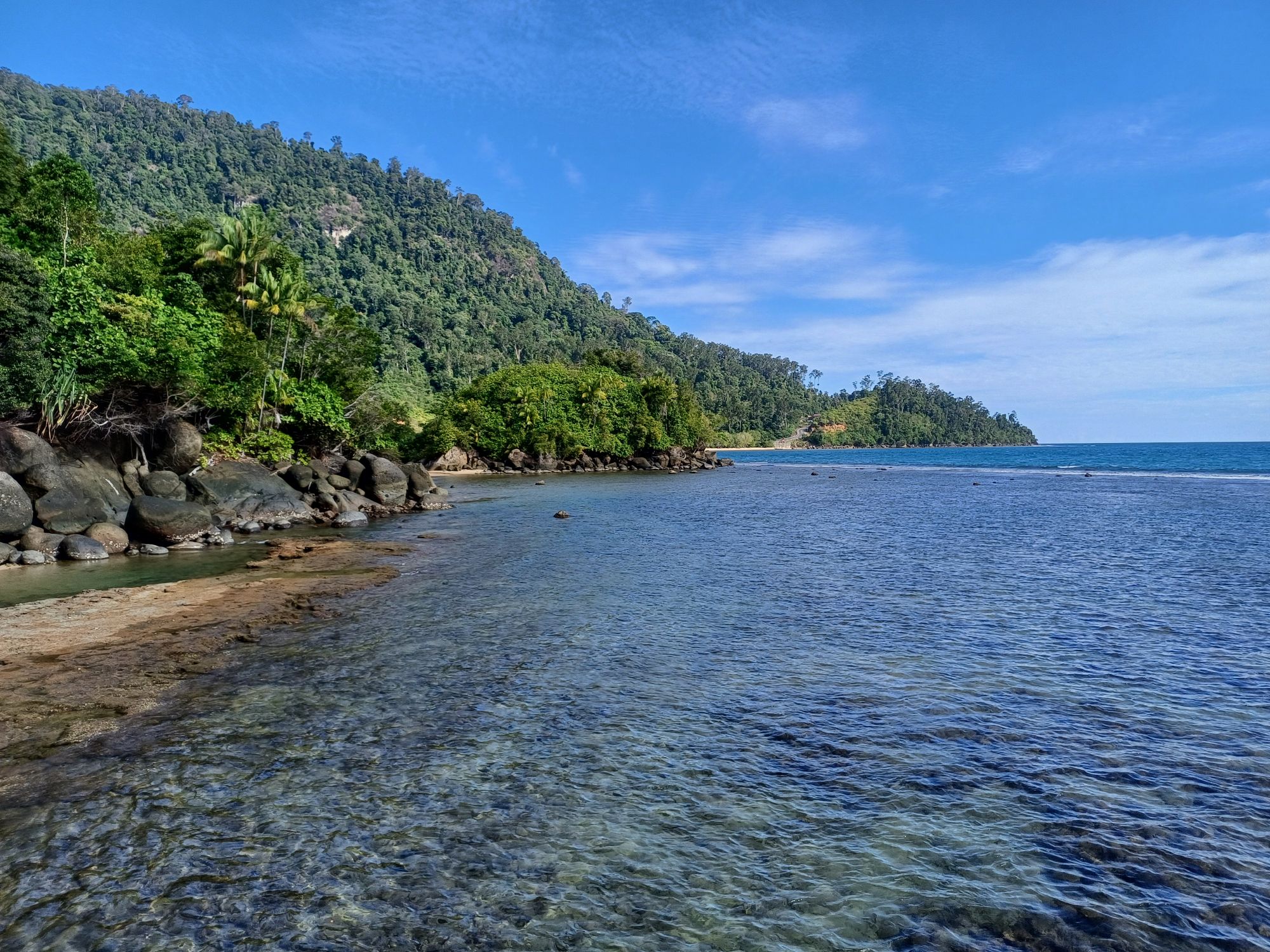
Sometimes when you’re travelling, you arrive somewhere where you just feel you’ve discovered a hidden sweet spot, a little corner of magic. Ricky’s was one of those places. A little bar, and a few of elegant low-rise bungalows set against a beautiful jungle-backed fringing beach, with spectacular vistas of a horseshoe bay…That’s Ricky’s. It’s the kind of place where you instantly get a warm, relaxed vibe, both from the locals who work there and the bunch of young backpackers who welcomed me with easy smiles at the bar.
I sat down and ordered me and Dudi a couple of drinks.
Chillin’ out with a mango shake, Dudi, who was originally from Jakarta, was clearly impressed. ‘This place is nice! I’ll have to bring more people here!’ He exclaimed…
Conservation in action
I quickly got talking to some of the girls who were volunteering at Ricky’s. Ricky himself, who was from the village just around the bay, wasn’t around, but the girls were happy to explain. In return for reduced rates, the girls were teaching English and environmental awareness at the school in the village.
Ricky was running a program which was growing and restoring corals on the fringing reef, directly in front of the guesthouse. He ran a turtle conservation project in conjunction with the local community. Both Green and Hawksbill turtles call the bay home (More on this later). Ricky also coordinated beach clean-ups, an essential project for a country that is the world’s 2nd largest source of plastic pollution. I could sense the belief and enthusiasm in the girls, the feeling that they were making a real difference. That empowerment itself is a major victory. This world needs more hopeful stories!
Regrowing the reef
I decided to take a dip and check out the marine life of the reef for myself. It was impossible to walk straight from shore without damaging the corals, due to the shallow nature of the reef, so I chucked myself in from the end of the pier.
The reef wouldn’t win any awards as a remarkable dive site, but there were a good amount of healthy corals, and plenty of small/midsize tropical fish: parrot fish, butterfly fish, morrish idols, and triggerfish. Compared to snorkelling at my local spots in the Mediterranean, it was a mega diverse wonderland. I could see the sections where Ricky was regrowing the branching corals on ropes beneath the pier. Once established, the corals would be relocated onto damaged sections of the reef. I hauled myself out of the ocean after a satisfying hour under the waves. It was late, and I knew that Dudi and I would soon have to start heading back to Padang.
Race to freedom
Before that, there remained the days’ crowning treat. A couple of the volunteer girls led me down to the turtle hatchery. Eggs are collected from the beach when the turtles lay. Previously, that might have been the end of their journey, collected by the local people for food, or eaten by the local wildlife. Now, the eggs are collected and hatched, and the young turtles are placed in large nursery pools, ready for release.
Many of Ricky’s guests gathered, and we each selected a turtle, making a voluntary contribution to the project. I selected a tiny Hawksbill juvenile, who flailed his flippers in my palm. We then walked down to the beach for the main event…the turtle race and release. Given a signal, we all released our turtles on the beach, watching who would make it to the sea and freedom first! It was an inspiring experience. I cheered my little hawkbill on, as he struggled towards the waves. He wasn’t the winner, but I felt a rush of elation as a wave carried him to freedom. My little male will never return, but the females, if they survive their perilous odyssey, will return to this very same beach after 25 years. As adults, they will give birth to the next turtle generation. This was conservation in action.
Inspiration’s glow
We left Ricky’s as the sun began its slide into the Indian Ocean. With the warm wind in my hair, I felt the glow of a truly inspiring day. It was a little bit of magic. I would love to return to Ricky’s one day, for a longer period. Community conservation needs more projects like this…
The ‘bus’
The following day, I set out for Kerinci. Bus travel in Sumatra is somewhat notorious, and not for positive reasons. Like many local ‘buses’ in Sumatra, they come round and pick clients up from their homes/guesthouses. This ‘bus’ was actually a large estate car, and turned up a few hours late. It was somewhat reminiscent of rough-and-ready transport in the Indian Himalaya. For the next hour, we drove around, ramming more and more clients into the car, until it was bursting at the seams. My backpack was strapped to the roof to make a little extra room, lashed under a somewhat dubious-looking tarpaulin.
Finally, we were on our way, leaving the coast behind and heading for the mountains. The ride made up for the slow start as the route was spectacular. The only slight downer was that the driver, perhaps 25, like most adult men in Sumatra, seemed determined to smoke himself to death within the space of the journey. To avoid a similar fate, I assiduously kept the window open. Hopefully, I avoided lung cancer.
On the road
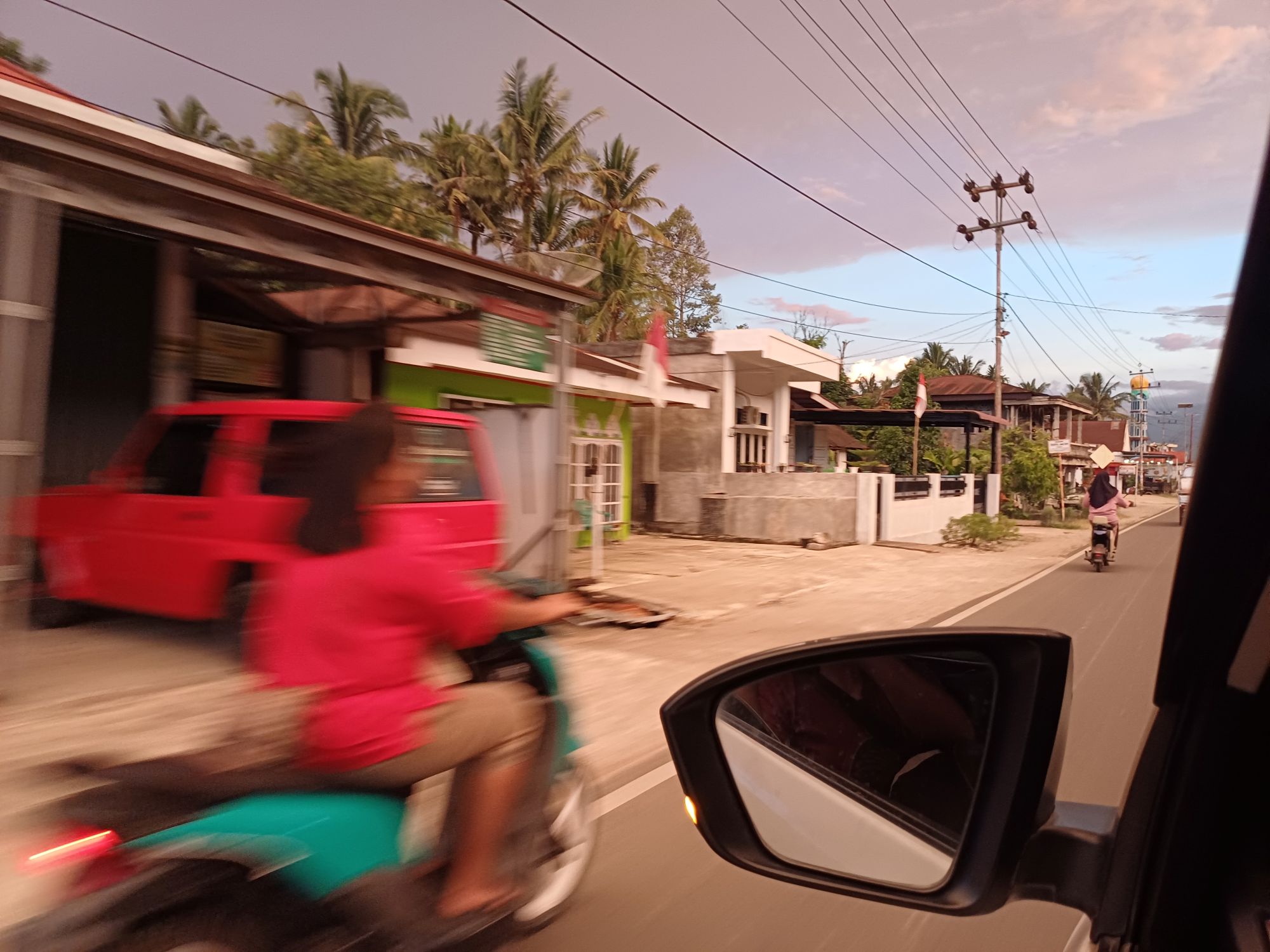
We quickly entered the forest, the road curving up the left side of a steep valley. From looking at the map, this swathe of wilderness appeared to be protected within Kerinci, but we were heading for a far more remote section of the National Park. Long-tailed macaques sat expectantly along the roadside, anticipating any human treats thrown their way. Macaques are highly adaptable primates, and, when tolerated, they quickly adapt to more ‘urban’ ways. Nevertheless, it was nice to see.
Leaving this coastal forest behind, we entered a heavily cultivated highland area, driving through what looked like tea plantations. We passed the expansive Lake Diatas and the town on its shoreline. Turning south, we left the highway behind, heading towards the Kerinci Valley. The scenery became wilder, tropical forest lining the steep sides of the valley, while a string of small villages and homesteads edged the road. Small-scale agriculture, rice paddies and subsistence farming seemed to be the norm here. With the light beginning to fade, the great pyramid of the Kerinci Volcano became apparent at the head of the valley, before nightfall claimed the scenery.
The long road ahead
It was a long, seemingly endless drive through the night. With the darkness came the rain and a thunderstorm that cleaved the night sky with lightning. Our ‘bus’ dropped everyone off at their houses, and we spent hours driving off to remote hamlets before retracing our steps to the main road.
At one point, we almost ran out of petrol. All stations we passed were either closed or out of fuel. The driver seemed to have little idea of where our final destination, in Lempur Village, actually was. As I was the last passenger, it was long past midnight, and we were still driving. I watched the fuel gauge nervously, thinking we might end up out of petrol and marooned for the night in the middle of nowhere. Finally, around two in the morning, exhausted, we arrived at the friendly homestay in Lempur. Knowing I had to be ready to hike at 8 or 9 the next morning, I just collapsed on the bed and tried to catch as much shut-eye as possible.
Sunrise in Lempur
The morning and my alarm came all too quickly. Foggy-eyed, I dragged myself into the shower and packed my gear. I staggered out of my room, and the friendly landlady made me some tasty breakfast. A coffee made me feel more human.
The scenery – rice paddies and vegetable gardens, backed by looming forested mountains, was certainly lovely. A water buffalo in the field stared idly over at me, unfazed by anything but the insects harassing it. I got talking to the only other guest up so early, an Australian girl who was leaving that morning. She was a zookeeper, friendly and open, who was also obsessed with Sumatran tigers, having one of these cats as her charge back in the land of Oz. She had desired to see one in its natural habitat. Unfortunately, she’d got sick a night into her trek and had to turn back…nevertheless, she seemed a passionate and positive soul, and one unfazed by a little bad luck. Soon, a couple more trekkers joined us, who, I assumed, wrongly, I’d be trekking with.
Video note: I found out later that the volcano I passed that night was indeed Gunung Kerinci!
A protected area?
An hour later, Hutmi, Zalo, Heggel and I were bouncing down a dirt track in a pickup truck towards the national park. A black eagle circled the valley, scanning the landscape for its next snack. We arrived at the park entrance, which was totally unmanned. I found this disturbing…who was protecting this place, the largest national park in Sumatra? For every day we spent in the park, we had to pay a national park ‘conservation fee’. Perhaps a little naively, I expected to see that money being invested in the protected area. It was a thought that I kept returning to during my time in Kerinci.
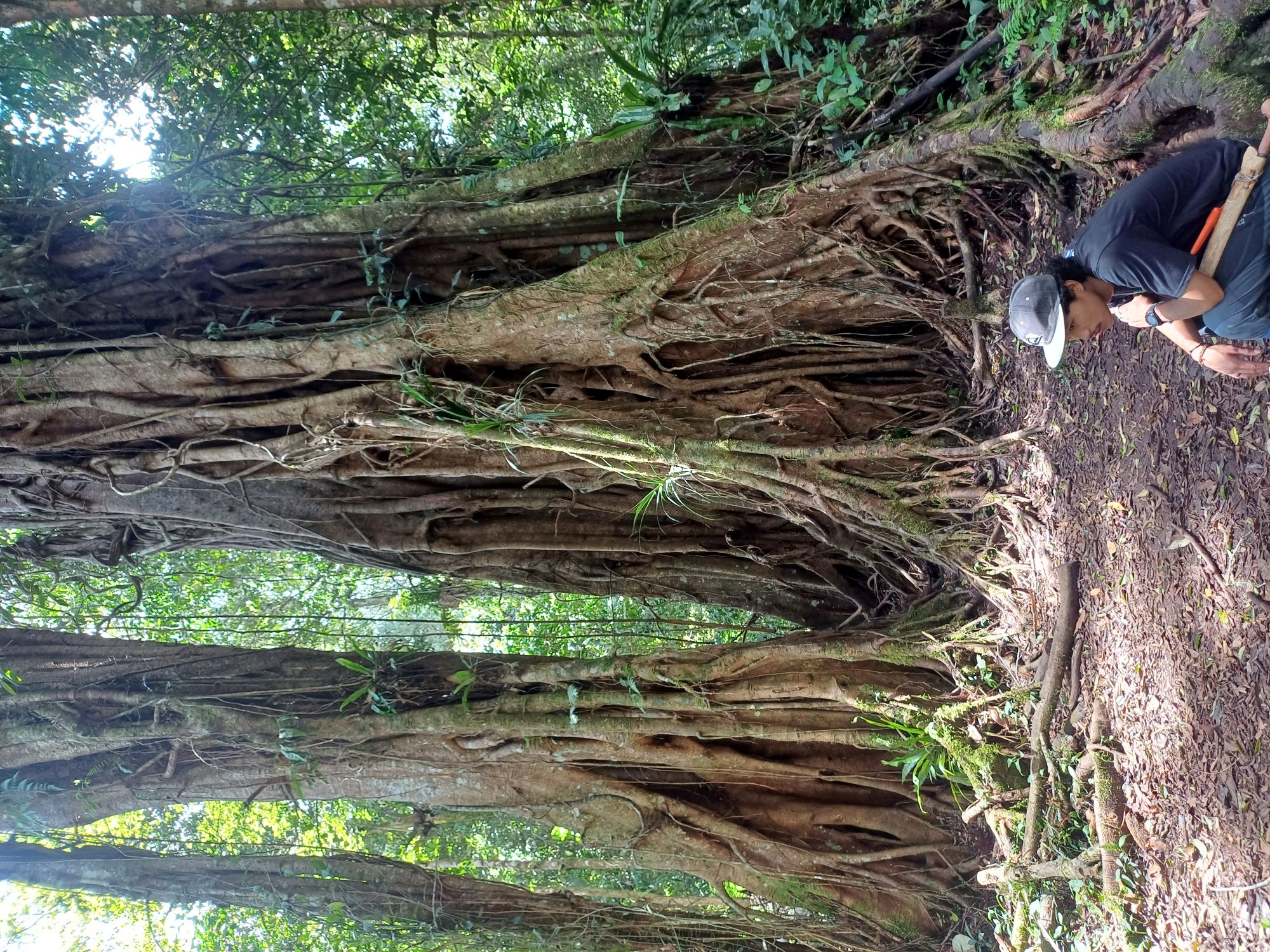
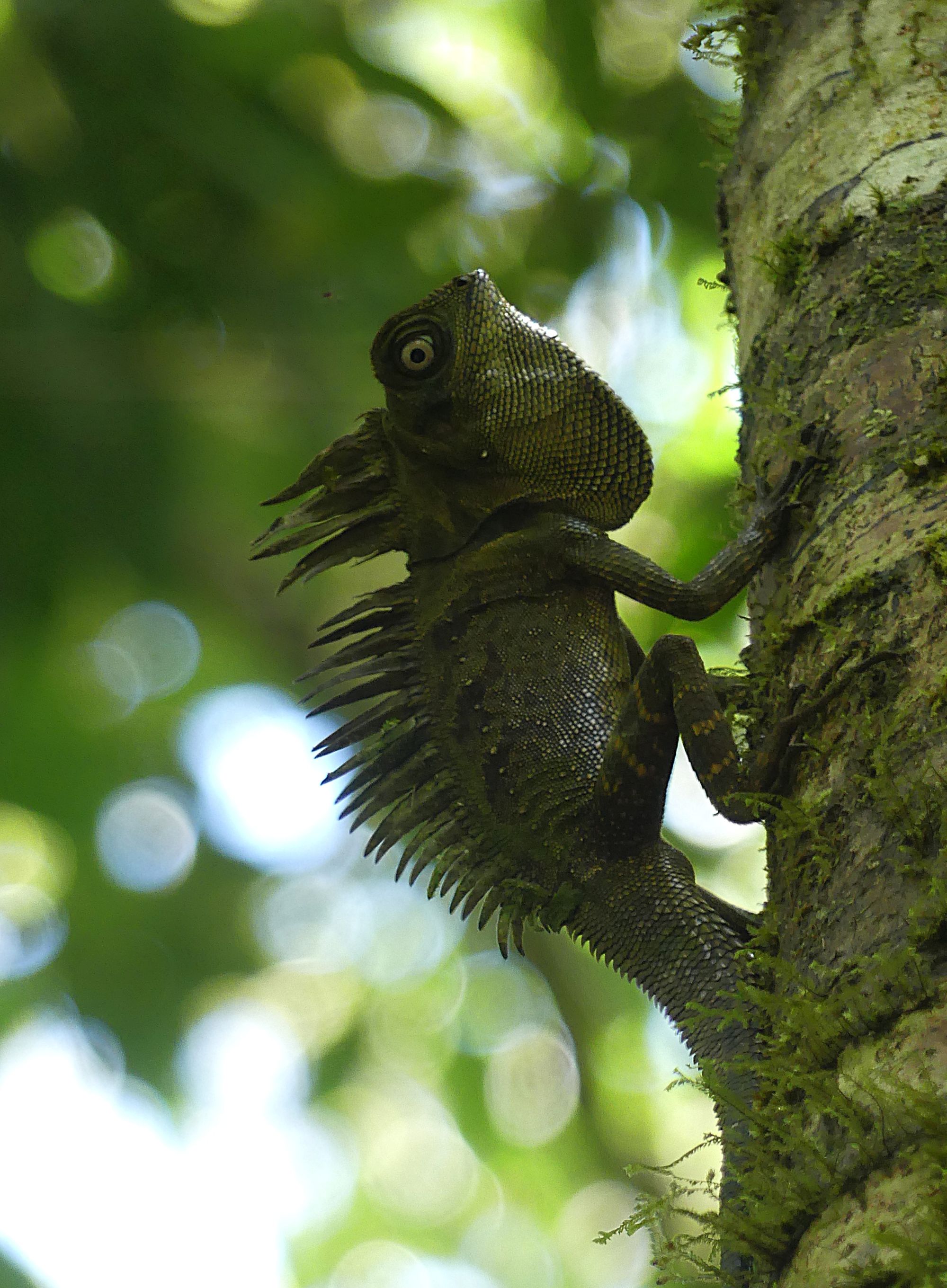
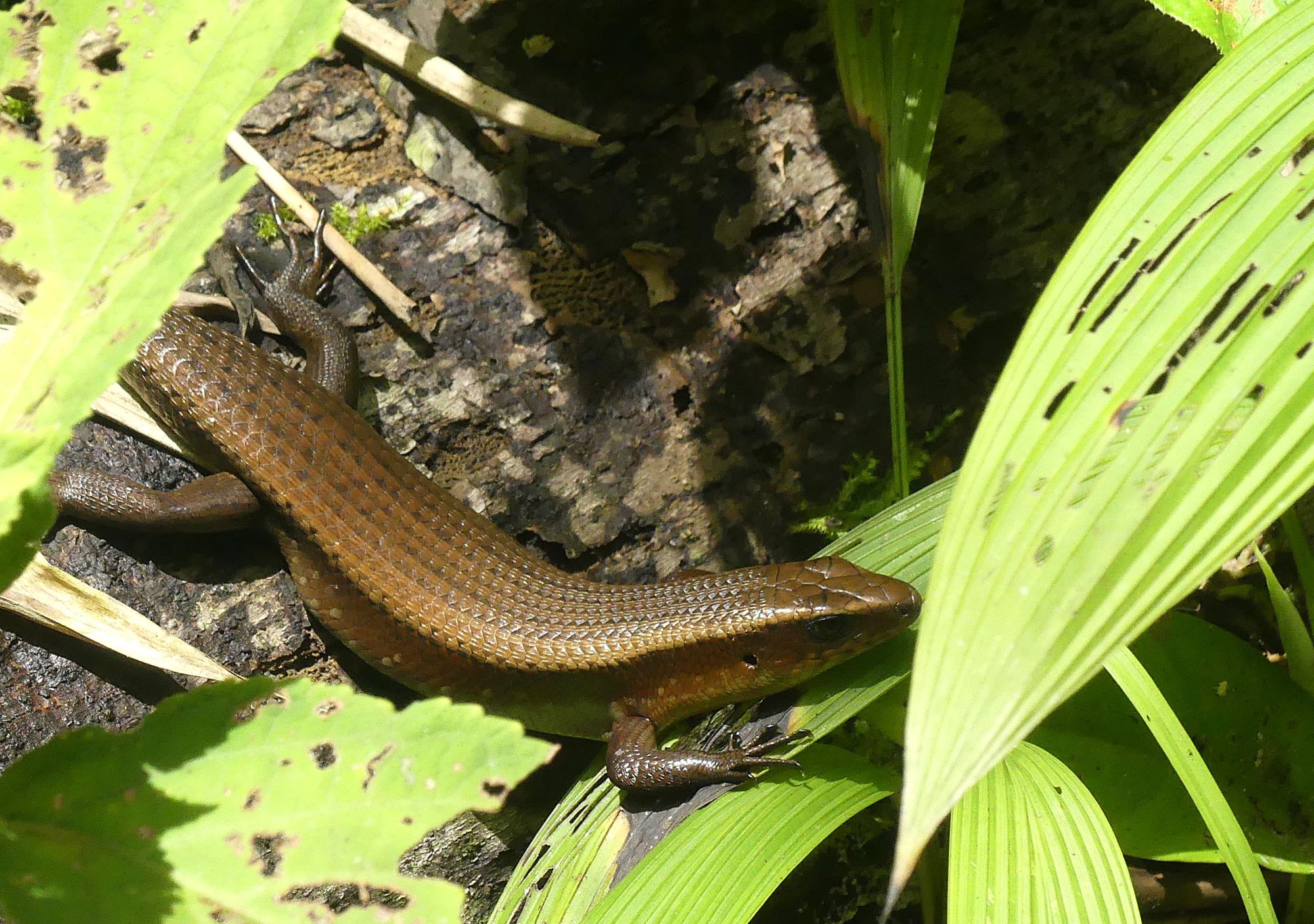
We headed into the forest, along a wide but muddy track, heading towards Lake Kaco, which would be our first camp. The beauty of the forest was undeniable. Butterflies and insects flitted through the undergrowth. As we walked, the rather scrubby secondary forest (forest that has been previously cut or cleared by people) gradually gave way to a forest of taller, primary rainforest trees. We stopped for a break under a cathedral-like strangler fig. Hutmi found a beautiful, though recently deceased, example of a Giant Atlas Moth. The insect’s wings spanned at least 20cm. The moth’s wingtips mimicked the form of serpents’ heads, perhaps a form that has evolved to protect it from predation. We also came across a beautiful forest dragon close by.
The Blue Lake
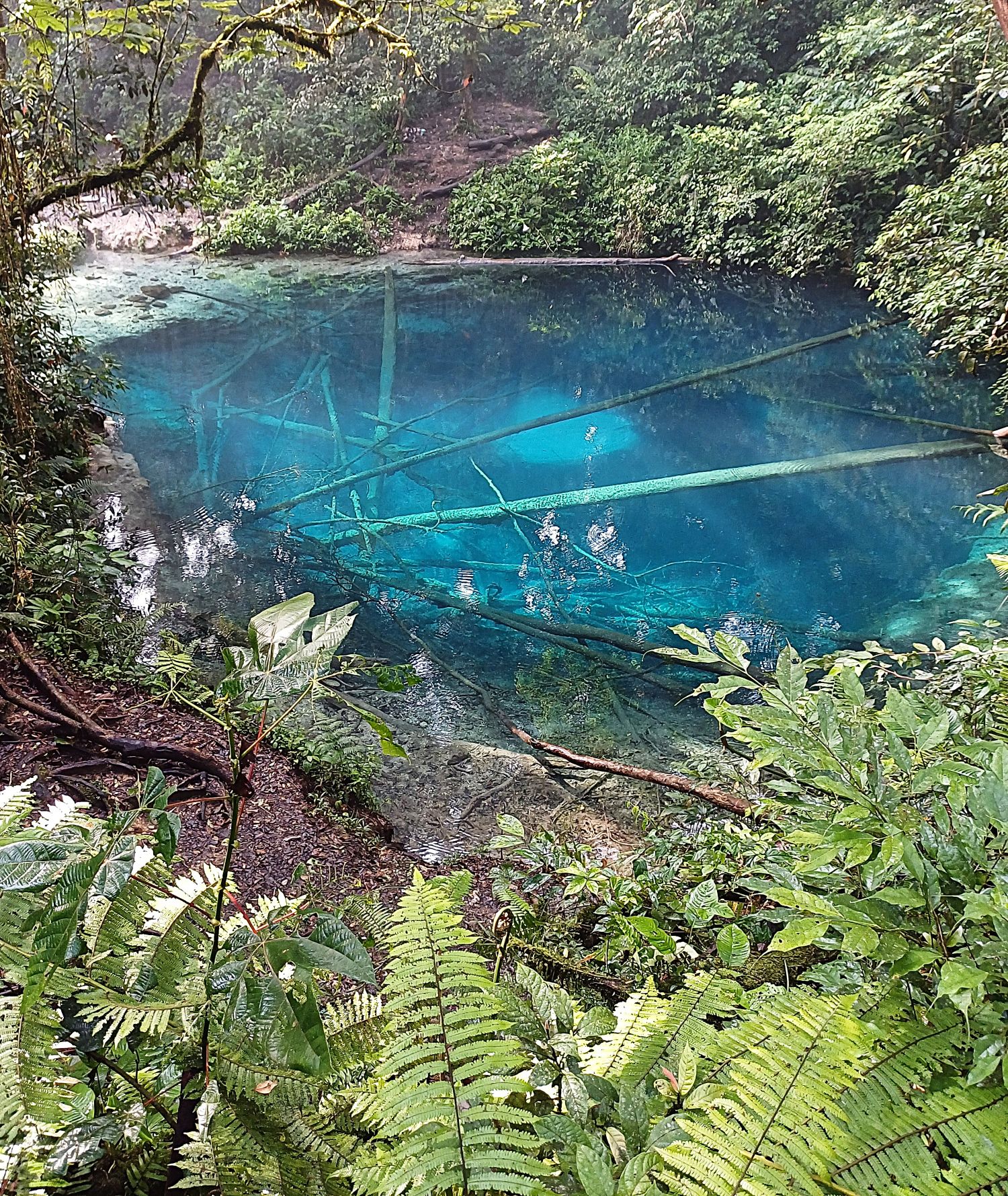
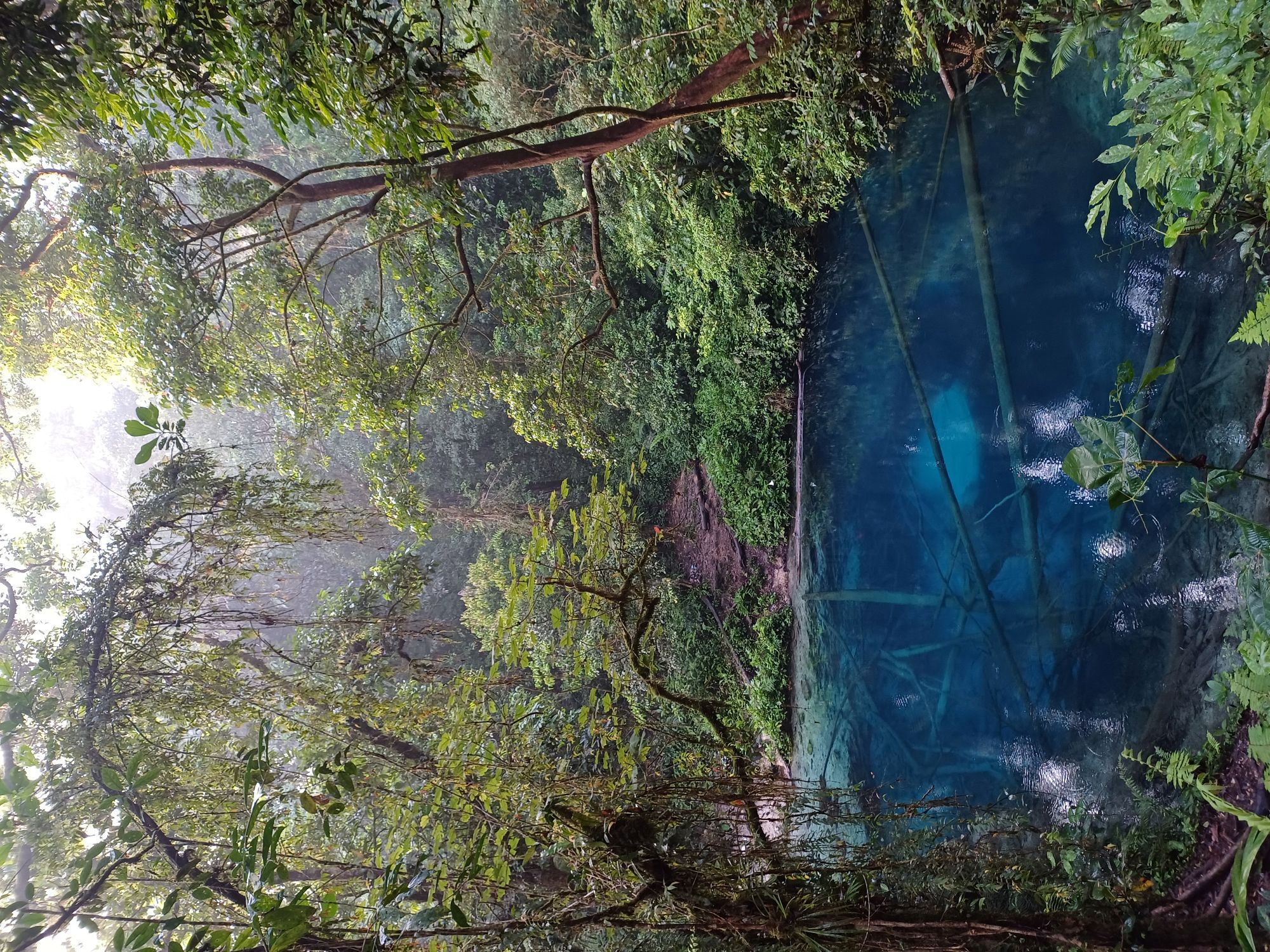
After a couple more hours and some serious wading through deep mud, we finally came to Lake Kaco and set up camp. True to the descriptions, the lake was a truly spectacular, luminous blue. Fish and colossal trunks of collapsed forest trees were visible beneath its crystalline surface.
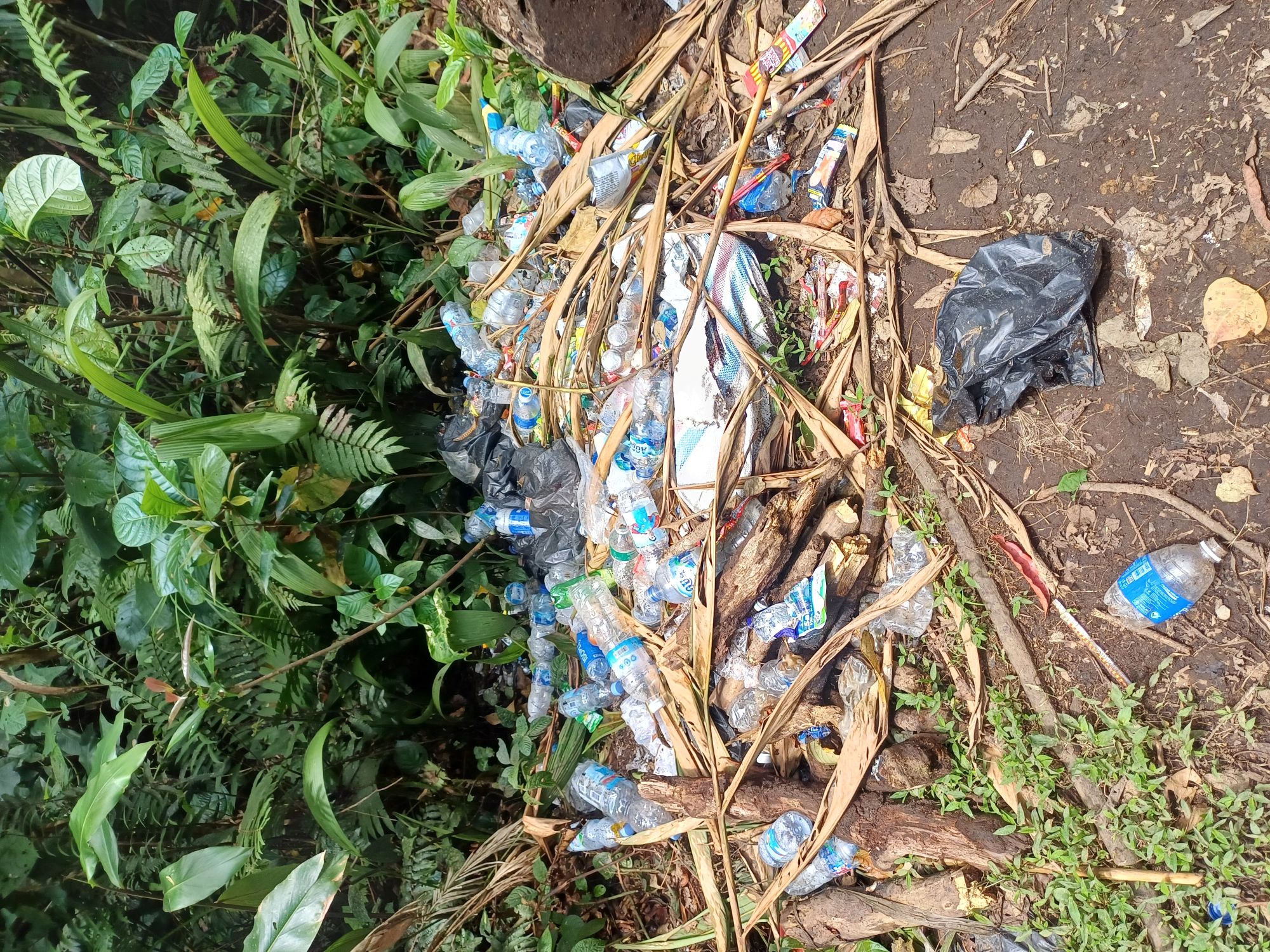
What wasn’t so beautiful was a huge pile of plastic trash, left by local Indonesian day trippers. Although apparently often cleared by park authorities, it seems that the concept of cleaning up your own plastic waste was still alien to the majority of the local populace. It was sad to see, and visible proof that environmental education and awareness is sorely lacking here.
I’d brought a mask and snorkel, so this seemed a perfect moment to explore beneath the surface; it would also wash away the sweat and grime of the day’s trek. Just at that moment, the heavens opened and rain began to slash down. Still, if you’re gonna get wet, you might as well do it properly! I slipped into the surprisingly chilly waters of the lake. I drifted over giant submerged trees and watched the schooling mahseer fish flit around me in the blue. Bubbles rose from the lake’s depths, ominous reminders of the lake’s volcanic origins. It had been a long but satisfying first day. The boys cooked me up a hot meal, and I promptly collapsed back into my tent to try and catch some much-needed shuteye.
The deep forest
The first day’s trek to Lake Kaco had been relatively straightforward. It was a clear, well-trodden trail frequented by locals, but beyond Kaco, things got serious. Any real hint of a trail fizzled away, and from this point forward, it was pure bushwacking, hacking a trail up through the dense foliage. Obviously, the boys knew their way and had left bits of plastic twine around trees and branches every few hundred metres to mark the route, but that was it. Any trail that had existed had been engulfed again by the forest. As the day progressed, our ‘apprentice’ guide, Heggal, began to flag. He was seriously under the weather due to a bee allergy. He managed to keep going, but it was touch-and-go.
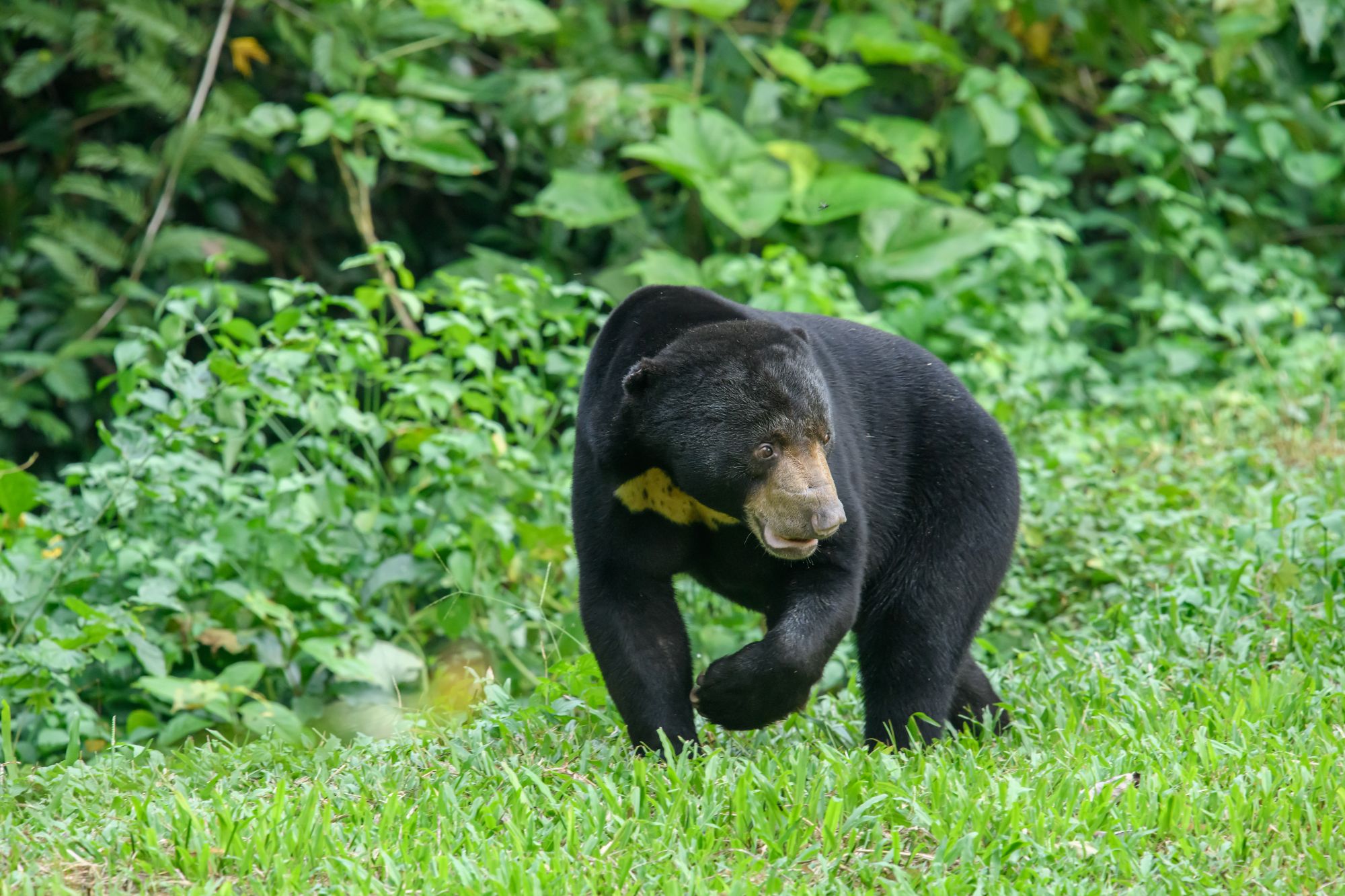
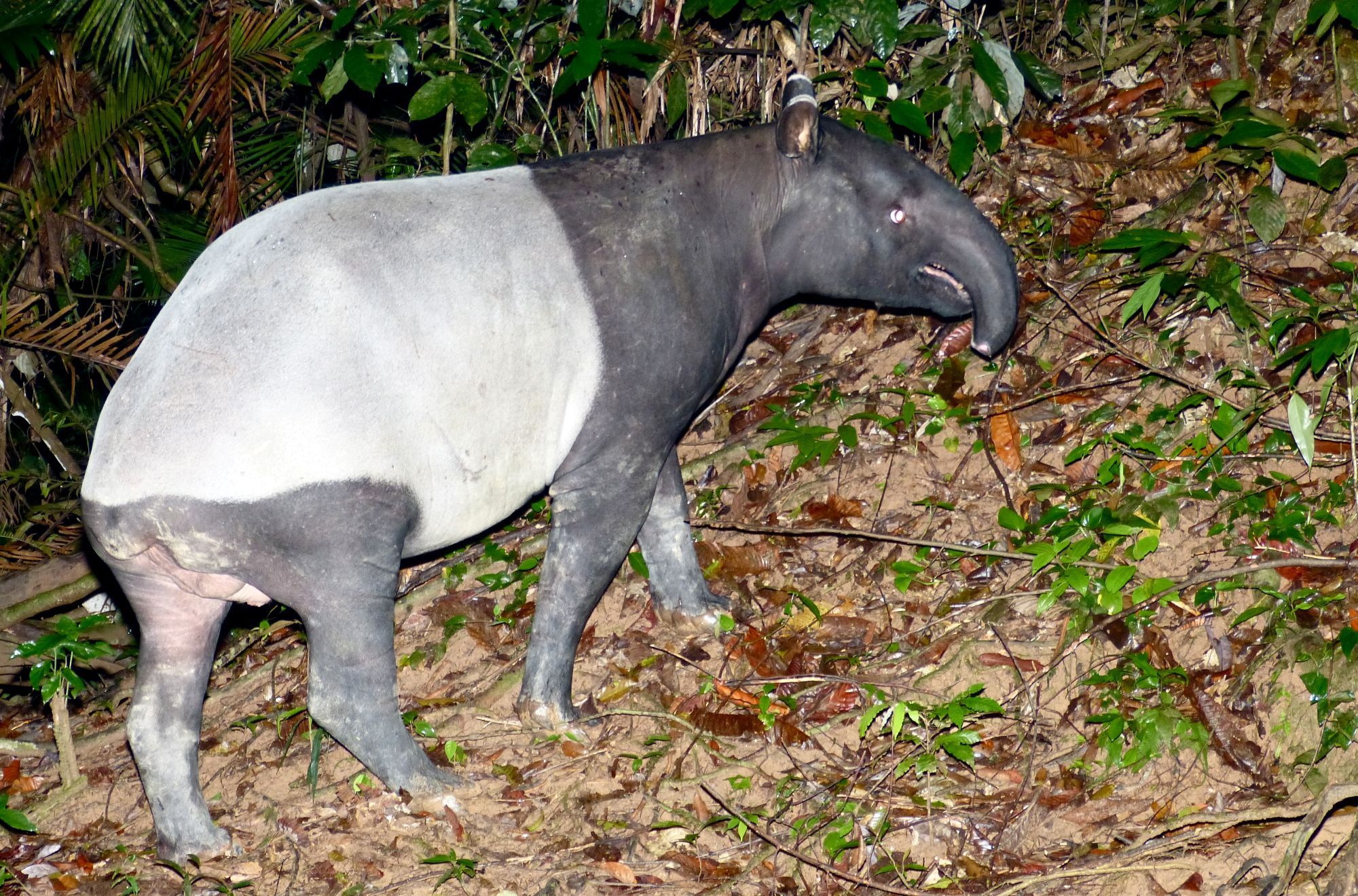
Struggling up the side of a hill, I faceplanted myself onto a particularly spiky plant, leaving myself bleeding out of my nose. Regardless, the forest was magnificent. This was a towering primary jungle, untouched by the axe. On one tree, we spotted the claw marks of a sunbear, a thrilling sight. A little further on, Hutmi pointed out the droppings of a Malaysian Tapir. Both are highly endangered species, and this was a clear sign of the enduring health of the ecosystem. It highlighted the importance of Kerinci as a critical refuge for these precious rainforest specialists.
A bloody affair
Before we reached camp, it was pouring again, which brought out the leeches in force. I love all types of wildlife, and every animal on this planet plays a unique role in the ecosystem, but these little fuckers sucked me dry that day and tested my patience to the max. By the time I reached camp, blood was dripping out of me, and I was riddled with holes! Time for refuge from the rain and the leeches! I clambered into my tent, stripping off and yanking off any remaining leeches from various parts of my body, hurling each of them out of the tent door with a curse. I watched my blood pool and seep into my sleeping mat.
The land that time forgot
Day three, and we set out once again, another tough day’s trek through the forest, climbing, slipping and sliding and up and down gorges and along steep ridges. What compensated for the difficulty was the obvious pristine nature of the environment. Colossal forest giants now dominated the forest completely. The forest had a timeless quality, still remote from the encroaching world outside.
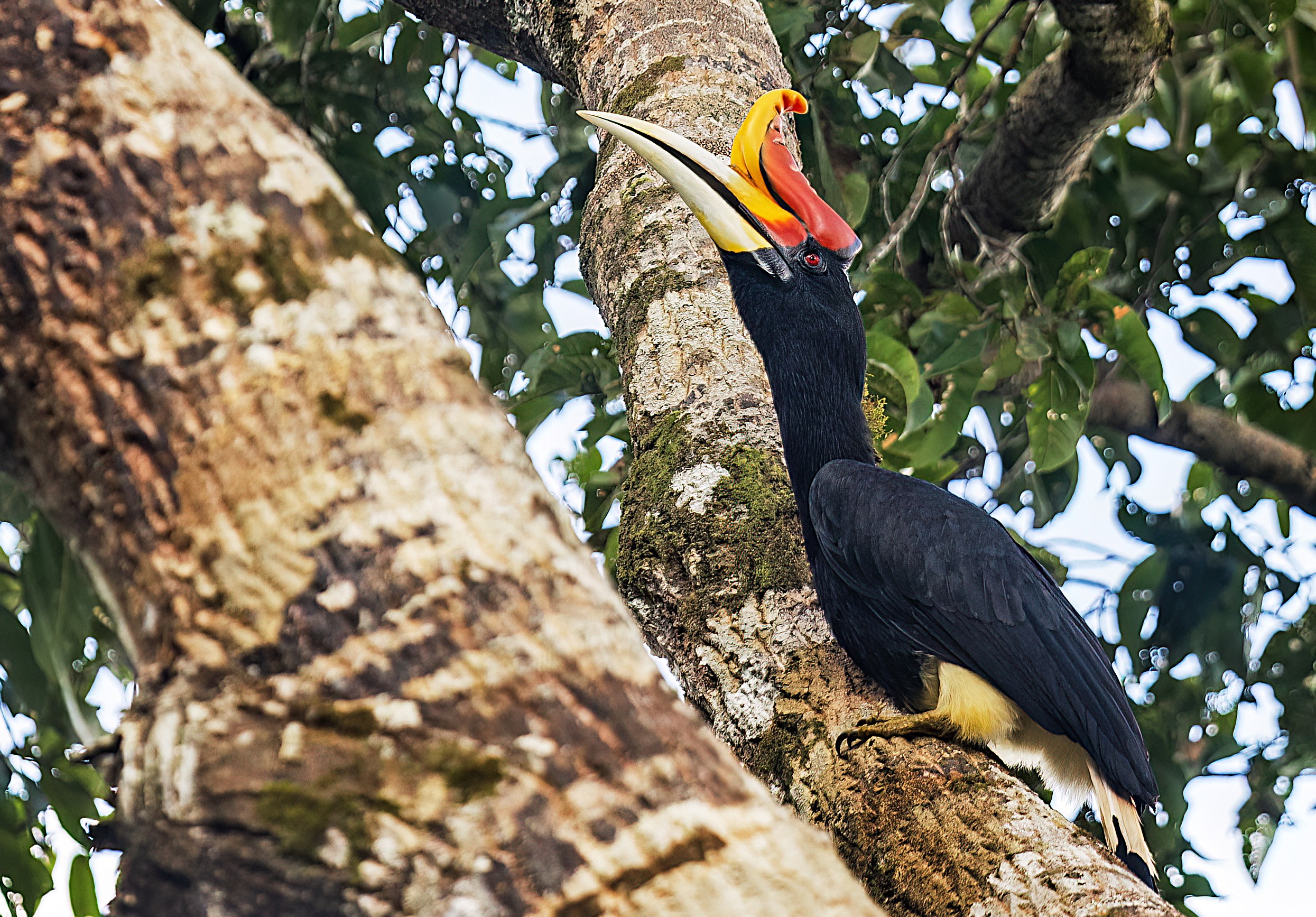
The signs of wildlife were everywhere, although sightings were difficult due to the dense nature of the forest. We came upon the nest of a black eagle, high in the forest canopy. Later, we surprised a group of Sumatran Surili monkeys, swinging and leaping from branch to branch as they dashed away in terror at the sight of the humans far below. We caught a glimpse of a giant squirrel, and, as we approached the Padang Lumut river, we heard the honking bark of rhinoceros hornbills as they glided over the jungle. After maybe six hours of trekking, we arrived at our camp beside the rushing river. The river and forest were beautiful, and I felt the wildness of the forest deep inside me, both alluring and intimidating. It was a primal place.
The next day, we would have to cross the river with all our gear. We would then spend the next full day hiking up another river gorge to our final camp. Staring at the churning, surging water in the river, I felt more than a tinge of fear.
Water World
That night, the heavens opened once again, swelling the river. As expected, the following day was difficult. I wasn’t worth trying to keep my boots dry – they were soaked anyway, and I would need all the protection they afforded for the day ahead.
We picked a likely looking spot where the current didn’t seem so savage, and sinking up to my waist, began the crossing. The cool current swirled around me, pushing against me, trying to drag me downstream. The boulder-strewn bed of the river was slick and slippery, but, with the help of the boys, I managed to cross without faceplanting myself into the river. We then headed upstream on the river’s left bank until we found our smaller stream. Splashing, wading and climbing up this waterway would be the day’s challenge. Again, this gorge was beautiful. Small cascades entered the gorge from either side. It felt prehistoric! You could easily imagine a velociraptor sticking its head out from behind a rock…
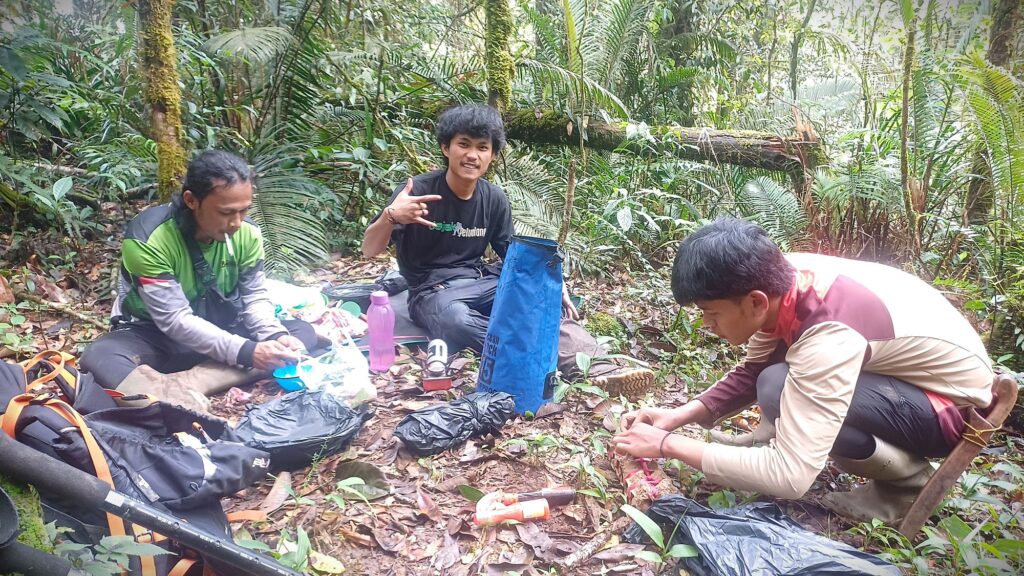
There were many times when I felt I was climbing myself into a trap, from which I couldn’t go further, with giant boulders and slick, moss-encrusted rocky walls all around. It was only the boy’s efforts, dragging me up the steep sections, that got me to camp. En route, Hutmi found a freshly shed snakeskin in the water, probably that of a King Cobra, and Heggel spotted a mouse deer downstream. It was my last night in the forest. The next day, we would hike out of the forest.
Last night in the forest
Part of me was desperate for a little pampering, a hot shower, the chance to actually dry out, clean myself up, and have a comfortable night’s sleep. But I had experienced a magical part of Sumatra’s wild heart, a place that must be preserved and protected, for humanity, but also for the myriad of magical creatures that call this forest home. The wilderness of Kerinci is harsh, but it is a magnificent, raw and untouched realm.
Goodbye to the wild things
The next day, we started the long hike back to civilisation. After a few hours, the magnificent primary forest began to give way to land logged and disfigured by people. Finally, we emerged into a valley of scattered homesteads and cinnamon plantations. As we left the forest, I once again heard the haunting call of the siamang gibbons, drifting through the trees, seemingly wishing us on our way. Goodbye to the wild things.
Civilization
A few hours later, I was back at the homestay. Everything that I had was caked in mud. My trekking trousers were so ripped to shreds it wasn’t worth considering repair. I just chucked them in the bin. Grabbing a shower, I changed into my last set of mud-free clothes and tried to clean up my gear with a shoe brush. Hutmi, Zalo and Heggel had been knowledgeable, patient, friendly, and giving guides throughout my adventure. Sitting in the restaurant with the guys, a hot coffee in my hand, I tried to make sense of the gruelling, wonderful experience that I had had.
The guys were all involved in a locally run conservation project in Lempur. The idea was beginning to spread in the village that money and a career could be made by protecting the forest, rather than destroying it to make way for new plantations. This, at least, was some small progress. But much more needs to be done.
A future for Kerinci?
Talking to Jared, the owner of Wild Sumatra, the company that had organised my journey, a couple of weeks later, we discussed many of the problems facing Kerinci.
One of these is the lack of actual protection of this amazing landscape. Where were the park guards? I hadn’t seen one during my time in the park. Also, considering its key role in the future survival of the Sumatran tiger, where were the scientists and the conservationists, who should be supporting them? Apparently, the Wildcat Conservation Alliance, along with Flora and Fauna International, are working in the park. They have certainly undertaken tiger surveys, but considering the scale and importance of the National Park, I feel this work needs to be upscaled. Also, it’s worth remembering that Indonesia doesn’t have the best reputation when it comes to allowing international NGO’s to work within its borders. Perhaps this is for fear of critique from outside organisations.
Jobs without destruction
We discussed the role of eco-tourism in Kerinci. Around the world, I have seen how eco-tourism can turn wild places and animals into an asset. It can provide jobs and opportunities for local communities, paying them to protect nature. In Kerinci, progress has certainly been made in Lempur, but this is just one community in a huge area – and, as I previously noted, few local people see the attraction and potential of Kerinci for wildlife-based tourism.
Jared expressed his frustration about this as he recounted trying to convince uninterested local leaders to improve infrastructure and protections in the area around Mount Kerinci. It’s an area that attracts tourists interested in climbing the country’s mightiest volcano, and it could be a huge draw – but this potential is still largely unrealised.
Gunung Leuser
Eco-tourism, and specifically the opportunity to see orangutans in their natural habitat, has only really taken off in one place in Sumatra, Bukit Lawang, in the Gunung Leuser National Park. Leuser is where almost all Western tourists head for a taste of jungle adventure. I feel Kerinci would greatly benefit if more of this ecotourism interest could be directed to its pristine wilderness.
The temptation to destroy
While highlighting local communities’ respect for nature and forest, Jared pointed out that for poor villagers, the temptation to expand plantations into the protected area, or hunt protected wildlife, is always present. Some locals may feel they have little choice. In order to protect this wilderness, other, less destructive ways to make a living must be on the table. If governments, NGO’s and eco-tourism interests can find a way to work together, then perhaps this wild corner of Sumatra has a future.
Ghosts
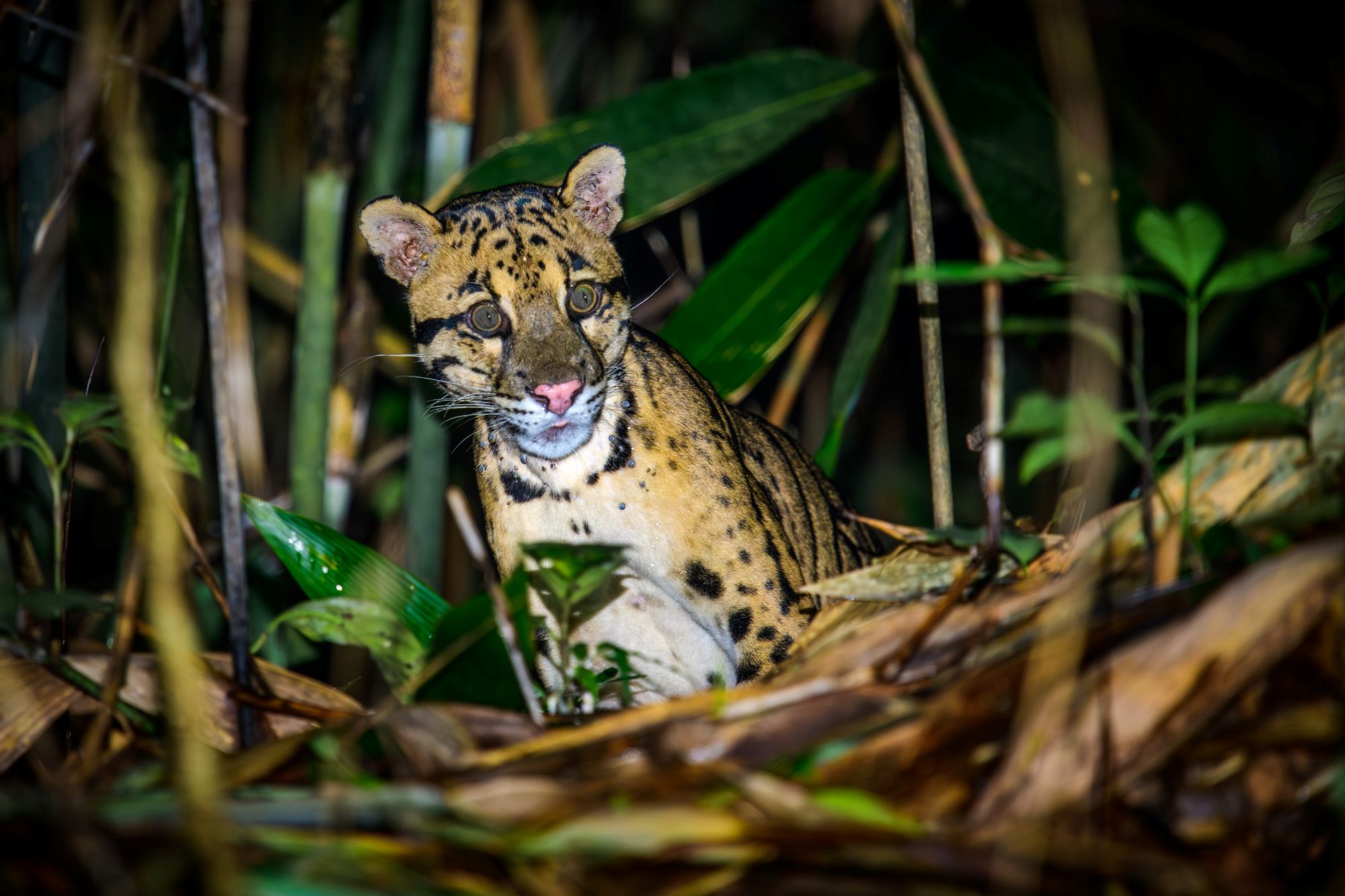
What is certain is that without positive action, these precious forests will vanish, consumed by humanity’s endless desire for resources. Without a home, the magnificent wildlife of Sumatra – tigers, rhinos, gibbons, clouded leopards, creatures of my childhood dreams – will become ghosts, nothing more than myth and memories. That is not a future I want to be part of.
Our Fight
We must all do our part to join the fight and protect places like Kerinci. It doesn’t matter whether it’s volunteering, like the girls down at Ricky’s, helping or working with conservation organisations. Joining sustainable eco-tourism trips, like those run by Wild Sumatra, incentivises locals to protect the forest. I might not have seen a Sumatran tiger on my trip – they are elusive wild spirits, but they are still there, holding on, and they need our help to survive.
How to help and how to make your journey happen!
I travelled to Kerinci Seblat with the help of Wild Sumatra, who arranged the itinerary. The company can arrange a wide range of excellent itineraries in the Kerinci region. These include guided treks, specialist wildlife-focused itineraries, and climbs of the region’s mighty volcanoes, including Gunung Kerinci itself. They can also arrange transfers from Padang up to Lempur Village. If comfort rather than budget is your primary concern, I would recommend a private driver, so that you can enjoy the drive up from the coast and stop at scenic points.
You can contact Wild Sumatra through their website: http://www.wildsumatra.com or call +62 812 6017 3651
Local community conservation project Pencagura can be contacted through Zacky on: +62 81366319255. With a minimal budget, any possible assistance is greatly appreciated.
You can find out more about big cat conservation through WildCats Conservation Alliance: http://www.conservewildcats.org
Panthera, a conservation organisation focused on the protection of big cats, is also an excellent source of information: http://www.panthera.org
I would also highly recommend Ricky’s Beach House, for the beautiful location, mellow vibe, and the great conservation work they are undertaking there: http://www.rickysbeachhouse.com
Please also subscribe to my YouTube Channel: The Lacandongringo:
https://www.youtube.com/channel/UCp7EyfHJUvPH1osA9K2–Pw